

What Does “Jobs Existing in Significant Numbers” Mean in a Social Security Disability Case?
One of the most frustrating things a Social Security Disability claimant can hear at the end of a hearing is something like this: “Although you cannot return to your past work, there are other jobs that exist in significant numbers in the national economy that you can perform.”
To most people, that statement makes little sense. “If I can’t do the only job I’ve done for the last 30 years, how can Social Security say I can do some other job?”
This is a reasonable question—but it reveals one of the biggest differences between Social Security Disability law and Alabama workers’ compensation law.
Neither Alabama Workers’ Compensation or Social Security claims stop after deciding you cannot return to your old job. In a workers’ comp claim, after it has been determined an injured worker cannot return to their job, the question turns to whether the worker has suffered a loss in earning capacity; in a disability claim, the question becomes whether jobs exist in significant numbers in the national economy which the claimant can perform.
This Is One of the Biggest Differences Between Social Security and Alabama Workers’ Compensation Claims.
Alabama workers’ compensation often asks:
- Can the worker return to reasonably suitable employment?
- Is comparable employment available in the local market?
- Can the worker earn wages similar to those earned before the injury?
Social Security first asks: Can you perform your past relevant work? If the answer is yes, the claim is generally denied.
If the answer is no, the analysis moves to what disability attorneys call Step Five. At Step Five, Social Security asks an entirely different question: Can you perform any other work that exists in significant numbers in the national economy?
That single question decides thousands of disability claims every year.
Recommended Reading: What Happens If I Can’t Return to My Job After a Work Injury? Workers’ Compensation and Social Security Disability Explained
Recommended Reading: Can I Be Found Disabled by Social Security but Denied Permanent Total Disability Benefits in My Workers’ Compensation Case?
Recommended Reading: How can I be determined to be disabled in my workers’ compensation case, but denied Social Security Disability Benefits?
What Does “Significant Numbers” Mean?
Federal regulations provide the basic answer. Social Security considers work to exist in the national economy if jobs exist:
- in significant numbers either where you live or
- in several other regions of the country.
Importantly, Social Security specifically states that it does not matter whether:
- an employer currently has an opening;
- you would actually be hired;
- there are jobs available in your immediate town or county; or
- your local unemployment rate is high.
Likewise, isolated jobs existing in only a handful of locations generally do not satisfy the regulation. Notice what the regulation doesn’t do-it never defines exactly how many jobs constitute “significant numbers.”
See: 20 C.F.R. §§ 404.1566 & 416.966
Having said this, U.S. District Courts within the 11th Circuit (where Alabama lies), have indicated that if less than 10,000 jobs are found nationally, or less than 1,000 regionally, there is a question as to whether jobs in significant numbers actually exists
This Is Why Vocational Experts Matter
Most disability hearings include testimony from a Vocational Expert (VE).
The vocational expert does not decide whether you are disabled. Instead, the vocational expert answers hypothetical questions posed by the Administrative Law Judge.
For example, the judge may ask:
Assume an individual of the claimant’s age, education, and work history who is limited to light work, can occasionally stoop, cannot climb ladders, can occasionally handle and finger with both hands, and cannot perform overhead reaching with the dominant arm. Are there jobs such a person could perform?
The vocational expert then identifies occupations and estimates how many such jobs exist nationally. That testimony often becomes one of the most important pieces of evidence in the case.
Recommended Reading: I Can’t Do My Old Job Anymore. Why Does Social Security Think I Can Do Another One? Understanding Transferable Skills
Recommended Reading: What is the Role of a Vocational Expert
The vocational expert does not simply identify jobs at a particular exertional level; instead, every medical limitation may reduce the number of available occupations.
Imagine a claimant limited to light work.
Now add:
- occasional reaching;
- occasional handling, fingering, bilateral dexterity;
- the need to use a cane or other walking assistive device;
- no overhead reaching;
- a sit/stand option;
- no production-rate pace;
- occasional stooping; and
- time off task due to pain or medication side effects.
Each additional restriction may eliminate hundreds—or thousands—of occupations, and take a job out of the light duty category and into the range of sedentary work.
Eventually, there may simply not be enough jobs remaining. That is why detailed medical evidence and accurate permanent work restrictions are so important.
Recommended Reading: What Do Permanent Work Restrictions Mean in Workers’ Compensation and Social Security Disability Cases?
Why Hand Restrictions Often Become So Important
Many people think a hand injury is relatively minor compared to a back injury, but restrictions in the use of one’s hands is often a more serious vocational limitation.
Recommended Reading: Why Reaching, Handling, Fingering, and Feeling Matter in Workers’ Compensation and Social Security Disability Claims
Recommended Reading: Can a Hand or Wrist Injury Lead to Both Workers Compensation and Social Security Disability Benefits?
Pain, Medication, and Other Non-Exertional Limitations Matter Too
The number of available jobs is affected by much more than lifting restrictions. Vocational experts must also consider limitations caused by:
- chronic pain;
- medication side effects;
- impaired concentration;
- reduced pace;
- dizziness;
- fatigue;
- postural limitations; and
- psychological symptoms.
A worker who can physically lift ten pounds may still be unable to sustain competitive employment if pain or medication causes excessive absenteeism or difficulty maintaining concentration.
Recommended Reading: Can Pain Alone Keep Me from Working? Understanding Pain in Alabama Workers’ Compensation and Social Security Disability Claims
Recommended Reading: Why Postural Restrictions Matter in Workers’ Compensation and Social Security Disability Cases
Recommended Reading: Can the Side Effects of My Prescribed Medication Help Prove My Social Security Disability Claim?
Age Can Completely Change the Outcome
For older workers—particularly those who spent decades performing heavy manual labor—transitioning to new, lighter jobs may be far more difficult than for someone with transferable office or administrative skills.
In some situations, the Medical-Vocational Guidelines (commonly called the Grid Rules) direct a finding of disability based upon the combination of age, education, work history, and residual functional capacity.
Recommended Reading: How Age Affects your Claim
Recommended Reading: Understanding the Medical-Vocational Grid Rules in Social Security Disability Cases
At Powell & Denny, we have represented injured and disabled workers throughout Alabama for more than 30 years. We understand that serious claims are rarely decided by a diagnosis alone. They are decided by how the injury affects the person’s ability to function, work, and earn a living.
If you have questions about an Alabama Workers’ Compensation claim, or a claim for Social Security Disability benefits, don’t hesitate to contact the experienced attorneys at Powell and Denny today a free consultation; remember. Virtual appointments are available through Zoom so you can meet with one of the attorneys of Powell and Denny from wherever you live, and remember-there is no fee unless you win.
Powell & Denny: We Work When You Can’t.
Offices in Birmingham, Alabama and Huntsville, AL
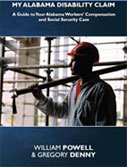
We Wrote the Book
My Alabama Disability Claim by William Powell & Gregory Denny Click Here to Get Your Free Copy


-
 5.0/5.0
A++++++ got results and staff is friendly
-
5.0/5.0
A++++++ got results and staff is friendly
-
5.0/5.0
Persevering for 2-3 years to get my disability. Thank You.
-
5.0/5.0
Persevering for 2-3 years to get my disability. Thank You.
-
 5.0/5.0
William Powell is an excellent attorney and a leader in our local bar.
