

How Can I Be Disabled Under Workers Compensation But Denied Social Security Disability?
One of the most confusing situations an injured worker can face occurs when they are told: “You are permanently disabled under workers’ compensation,” but later hear: “Your Social Security Disability claim has been denied.”
Many people assume this must be a mistake. After all, if one system says you are disabled, shouldn’t the other system reach the same conclusion?
Not necessarily.
Although Alabama Workers’ Compensation and Social Security Disability both provide benefits to individuals who can no longer work, they use very different standards when determining disability. As a result, the same person may qualify for benefits under one system and be denied benefits under the other, so, in one case an injured worker may be entitled to both, and in another they are not.
Workers’ Compensation and Social Security Are Different Systems
The first thing to understand is that workers’ compensation and Social Security Disability were created for different purposes.
Alabama Workers’ Compensation
Workers’ compensation exists to compensate employees who are injured on the job. The focus is often on:
- The worker’s ability to return to their previous employment;
- Permanent physical impairment;
- Loss of earning capacity;
- Whether the worker can obtain reasonably gainful employment-
- Which includes similar pay.
Social Security Disability
Social Security Disability is a federal program, and the focus is not whether the injury occurred at work. Instead, Social Security asks: “Can this person perform substantial gainful activity on a sustained basis?”
These are very different questions.
Alabama Workers’ Compensation Often Focuses on Loss of Earning Capacity
In many Alabama workers’ compensation cases, particularly those involving non-scheduled injuries, the issue is not simply whether the worker has suffered a permanent impairment.
The issue is often “How has the injury affected the worker’s ability to earn a living?”
Courts may consider:
- Age;
- Education;
- Work history;
- Physical restrictions;
- Pain;
- Transferable skills;
- Future employability.
A worker may be found permanently and totally disabled if they can no longer perform their previous trade and cannot obtain other reasonably gainful employment.
What Does “Reasonably Gainful Employment” Mean?
Alabama courts have long recognized that disability is not determined solely by whether a person can perform some type of work. The question is often whether the worker can obtain employment that provides earnings reasonably similar to what they earned before the injury.
For example:
Imagine a 55-year-old master electrician earning $90,000 per year. After a serious back injury, he can no longer climb ladders, lift heavy materials, or perform electrical work. A vocational expert identifies a part-time greeter position paying a fraction of his previous income.
A workers’ compensation court may conclude that such employment is not reasonably comparable to the worker’s previous earning capacity. As a result, the worker may be entitled to permanent total disability benefits under Alabama’s workers’ compensation laws.
Social Security Uses a Different Standard
Social Security does not ask whether a claimant can earn wages similar to those earned before the injury. Social Security asks “Can the claimant maintain any substantial gainful activity that exists in significant numbers in the national economy?”
That distinction is extremely important.
Social Security may identify jobs that:
- Pay significantly less;
- Require different skills;
- Are performed in a different industry.
The issue is not whether the claimant can maintain their former standard of living; the issue is whether they can still sustainably perform competitive work.
A Real-World Example
Consider two workers.
Before Injury
Both workers:
- Earned $80,000 per year;
- Performed physically demanding labor;
- Had no college education.
After Injury
Both workers:
- Have permanent lifting restrictions;
- Cannot return to their former employment;
- Cannot perform heavy labor.
Under Alabama workers’ compensation law, a court may conclude that they have suffered a significant loss of earning capacity because they can no longer earn wages comparable to those earned before the injury. However, Social Security may determine that they can still perform certain sedentary jobs.
As a result:
- Workers’ compensation benefits may be awarded.
- Social Security Disability benefits may be denied.
The two outcomes are not necessarily inconsistent because the systems are asking different questions.
Why Vocational Experts Matter
Vocational experts frequently play important roles in both workers’ compensation and Social Security Disability cases, and their testimony is important; however, they may be asked very different questions.
In Workers’ Compensation Cases
The vocational expert may evaluate:
- Loss of earning capacity;
- Employability;
- Reasonably gainful employment;
- Ability to return to the labor market.
In Social Security Cases
The vocational expert may evaluate:
- Residual Functional Capacity;
- Transferable skills;
- Available occupations;
- Whether jobs exist in significant numbers.
The same vocational evidence can lead to different conclusions depending upon the legal standard being applied.
Can Someone Receive Both Workers’ Compensation and Social Security Disability?
Absolutely. Many seriously injured workers qualify for both programs; however, qualification under one system does not automatically guarantee qualification under the other.
Each claim must be evaluated under its own rules and legal standards, and that is one reason why workers who suffer serious work injuries should seriously consider hiring a lawyer who handles both Alabama Workers Compensation and Social Security Disability claims.
Why This Difference Matters
Many injured workers become discouraged when they receive a denial from Social Security after successfully pursuing a workers’ compensation claim. They assume the denial means they are not truly disabled-but that is not necessarily true.
In many cases, the denial simply reflects the fact that Social Security and workers’ compensation define disability differently. Understanding those differences is often the first step toward understanding why a claim was denied and whether an appeal may be appropriate.
A person can be considered disabled under Alabama workers’ compensation law and still be denied Social Security Disability benefits.
Likewise, a person may qualify for Social Security Disability benefits even when significant issues remain in a workers’ compensation case.
The reason is simple: The two systems are designed to answer different questions.
For decades, the attorneys at Powell and Denny have represented injured workers and disability claimants throughout Alabama and have extensive experience handling both workers’ compensation claims and Social Security Disability claims, so if you have suffered a serious injury and have questions about workers’ compensation benefits, Social Security Disability benefits, vocational disability, loss of earning capacity, or how these systems interact, don’t hesitate to contact the experienced attorneys at Powell and Denny today a free consultation; remember. Virtual appointments are available through Zoom so you can meet with one of the attorneys of Powell and Denny from wherever you live, and remember-there is no fee unless you win.
Powell and Denny: We Work When You Can’t.
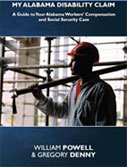
We Wrote the Book
My Alabama Disability Claim by William Powell & Gregory Denny Click Here to Get Your Free Copy


-
 5.0/5.0
A++++++ got results and staff is friendly
-
5.0/5.0
A++++++ got results and staff is friendly
-
5.0/5.0
Persevering for 2-3 years to get my disability. Thank You.
-
5.0/5.0
Persevering for 2-3 years to get my disability. Thank You.
-
 5.0/5.0
William Powell is an excellent attorney and a leader in our local bar.
