

What Happens If I Don’t Fully Recover? Understanding Permanent Disability Benefits in Alabama Workers Compensation Claims
Most workers hope that after medical treatment they will recover completely and return to work. Unfortunately, that does not always happen; some work injuries leave lasting effects that continue long after treatment has ended. When this occurs, one of the most important questions becomes:
“What benefits am I entitled to if I have a permanent injury?”
The answer depends on the nature of the injury, the body parts involved, and how the injury affects your ability to work.
The First Step: Reaching Maximum Medical Improvement (MMI)
Before permanent disability benefits can be evaluated, an injured worker must generally reach Maximum Medical Improvement (MMI).
MMI is the point at which the Authorized Treating Physician believes your condition has improved as much as it is likely to improve with medical treatment. This does not mean you are fully recovered, it simply means your condition has stabilized and your physician can now evaluate whether any permanent impairment remains.
What Is a Permanent Impairment?
A permanent impairment is a lasting physical condition caused by a work injury that remains after medical treatment has been completed.
Some workers recover completely, others are left with:
- chronic pain;
- loss of strength;
- reduced range of motion;
- nerve damage;
- permanent work restrictions; or
- other lasting limitations.
When this occurs, the treating physician will often assign an impairment rating, frequently using the American Medical Association (AMA) Guides to the Evaluation of Permanent Impairment, and while impairment ratings are important, they are often only part of the analysis.
Scheduled Injuries
Alabama’s Workers’ Compensation Act treats certain body parts differently. These are known as scheduled injuries.
Examples include injuries involving:
- fingers;
- thumbs;
- hands;
- arms;
- toes;
- feet;
- legs;
- knees;
- hearing; and
- vision.
For these injuries, Alabama law establishes a specific number of weeks of compensation associated with the affected body part and the amount of compensation is often based upon the extent of the permanent impairment to that scheduled member.
Unscheduled Injuries
Other injuries are classified as unscheduled injuries.
These commonly include injuries to:
- the back;
- neck;
- spine;
- shoulders;
- hips; and
- conditions affecting the body as a whole.
Unlike scheduled injuries, these claims often involve a broader analysis of how the injury affects the worker’s ability to earn a living. Factors that may become important include:
- age;
- education;
- work history;
- transferable skills;
- physical restrictions; and
- future earning capacity.
What If I Can Return to Work, But Not the Same Job?
Many injured workers fall into this category. For example: A construction worker may recover sufficiently to perform some work, but no longer be capable of heavy lifting, or a nurse may be able to work in a sedentary administrative position but no longer perform bedside patient care.
In these situations, the injury may have a significant effect on future earnings even though the worker is not totally disabled and the worker may be entitled to receive permanent partial disability (ppd) benefits
What Is Permanent Total Disability?
Some injuries are so severe that the worker is no longer capable of performing their previous employment and is unable to obtain other reasonable gainful employment. This is known as Permanent Total Disability (PTD).
One of the most common misconceptions is that permanent total disability means a person must be completely helpless; that is not the law in Alabama. A worker may still be capable of performing certain activities and yet qualify for permanent total disability benefits if their injury prevents them from maintaining reasonable gainful employment and receive similar remuneration.
In determining whether a worker is permanently and totally disabled, courts often consider:
- age;
- education;
- prior work experience;
- transferable job skills;
- physical limitations;
- medication side effects;
- the availability of suitable employment and
- similar remuneration
How Long Do Permanent Total Disability Benefits Last?
In Alabama, workers found to be permanently and totally disabled may be entitled to weekly compensation benefits for life, subject to the provisions of Alabama’s Workers’ Compensation Act. In addition, the employer generally remains responsible for reasonably necessary medical treatment related to the work injury.
What Happens to My Medical Benefits?
One important thing injured workers should understand is that permanent disability benefits and medical benefits are separate issues. Even after reaching MMI and receiving permanent disability benefits, the employer’s workers’ compensation carrier generally remains responsible for paying for:
- reasonably necessary medical treatment;
- medication;
- therapy;
- pain management;
- future surgery; and
- other authorized treatment related to the work injury.
For many injured workers, these future medical benefits are among the most valuable rights they possess.
Can I Also Receive Social Security Disability Benefits?
Possibly.
Workers who suffer severe permanent impairments may also qualify for Social Security Disability benefits. Because workers’ compensation benefits and Social Security Disability benefits can affect one another, it is important to understand how settlements and disability awards may impact future benefits.
Final Thoughts
Not every work injury results in a permanent impairment. However, when a worker does not fully recover, Alabama’s Workers’ Compensation Act provides benefits designed to compensate for the lasting effects of the injury.
Whether the injury involves a scheduled member, an unscheduled injury, a loss of earning capacity, or permanent total disability, understanding your rights is an important part of protecting your future.
At Powell and Denny, we have spent decades helping injured workers throughout Alabama understand and protect their rights after serious workplace injuries.
If you have suffered a job injury and you have questions about your rights and benefits under Alabama’s workers compensation laws -don’t hesitate to contact and speak with one of the experienced Alabama Workers Compensation and Social Security Disability attorneys at Powell and Denny today for a free consultation. Appointments are available in person, or virtually via Zoom if more convenient. Powell and Denny would appreciate the opportunity to help. And remember, there is no fee unless you win.
Powell and Denny: We Work When You Can’t
Offices in Birmingham and Huntsville, Alabama
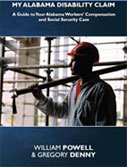
We Wrote the Book
My Alabama Disability Claim by William Powell & Gregory Denny Click Here to Get Your Free Copy


-
 5.0/5.0
A++++++ got results and staff is friendly
-
5.0/5.0
A++++++ got results and staff is friendly
-
5.0/5.0
Persevering for 2-3 years to get my disability. Thank You.
-
5.0/5.0
Persevering for 2-3 years to get my disability. Thank You.
-
 5.0/5.0
William Powell is an excellent attorney and a leader in our local bar.
