

What Happens If I Can’t Return to My Job After a Work Injury? Workers Compensation and Social Security Disability Explained
For many injured workers, the goal after a workplace injury is simple: heal, return to work, and move on with life. Unfortunately, that is not always possible.
Some injuries leave permanent restrictions that prevent a worker from returning to the job they have performed for years—or even decades. When that happens, injured workers often ask one of the most important questions in both workers’ compensation and Social Security Disability law:
“If I can’t return to my old job, what happens next?”
The answer depends on many factors, including the nature of your injury, your permanent work restrictions, your age, your education, your work history, and whether you possess skills that transfer to other types of employment.
While not being able to return to your former job does not automatically mean you are permanently and totally disabled, it often marks the point where both workers’ compensation law and Social Security Disability law begin looking beyond the injury itself and start evaluating your ability to work.
Returning to Your Old Job Is Often the First Question
After reaching Maximum Medical Improvement (MMI), your authorized treating physician will often assign:
- permanent work restrictions;
- an impairment rating;
- and sometimes recommend a Functional Capacity Evaluation (FCE).
Those restrictions may include limitations such as:
- no lifting over 20 pounds;
- no overhead reaching;
- limited standing or walking;
- no climbing;
- limited use of one hand; or
- the need to alternate sitting and standing.
The next question becomes: Can you still perform your previous job?
For some workers, the answer is yes-For others-particularly construction workers, healthcare workers, truck drivers, iron/steel workers, and other individuals performing physically demanding work—the answer is often no.
Recommended Reading: To better understand how doctors determine these restrictions, see:
- What Do Permanent Work Restrictions Mean in Workers’ Compensation and Social Security Disability Cases?
- How Functional Capacity Evaluations (FCEs) Affect Workers’ Compensation Claims
Workers’ Compensation Looks at More Than Your Medical Impairment
Many people assume their impairment rating determines the value of their workers’ compensation claim. Sometimes it does, often it does not.
If your injury is classified as a non-scheduled injury—such as an injury involving the back, neck, shoulder, hip, chronic pain, or an injury taken outside the statutory schedule—the court may also consider vocational evidence.
That includes factors such as:
- your age;
- education;
- past work experience;
- transferable skills;
- permanent restrictions;
- chronic pain;
- medication side effects; and
- your loss of earning capacity.
Additionally, if a worker has a scheduled injury, but their continued symptoms interfere with the proper functioning of their body as a whole, then these injuries can be viewed as being non-scheduled.
In other words, Alabama law recognizes that the same physical injury can affect two workers very differently. A 28-year-old accountant with lifting restrictions may continue working with little interruption. The same restrictions may end the career of a 58-year-old construction laborer.
Recommended Reading: These articles explain why some injuries are evaluated differently than others:
- Scheduled vs. Non-Scheduled Injuries Under Alabama Workers’ Compensation Law
- Can Pain Alone Keep Me from Working? Understanding Pain in Alabama Workers’ Compensation and Social Security Disability Claims
What about the Side Effects of Medication?
Many workers assume that an injury involving a hand, foot, leg, or arm will always remain a scheduled injury, but that is not always true.
Sometimes the injury leads to:
- permanent nerve damage;
- Complex Regional Pain Syndrome (CRPS);
- chronic pain;
- altered gait;
- medication side effects;
- or limitations affecting the body as a whole.
When that happens, the injury may no longer be confined to the statutory schedule, opening the door to consideration of vocational disability and loss of earning capacity.
Recommended Reading: Learn more about these important issues:
- What Is Permanent Nerve Damage and How Does it Affect My Claim?
- Complex Regional Pain Syndrome (CRPS): When a Work Injury Leads to Chronic Pain
- How Altered Gait Can Affect Both Workers’ Compensation and Social Security Disability Claims
How Pain Effects a Claim for Alabama Workers’ Compensation and Social Security Disability Benefits.
Pain and Psychological Issues
Social Security Asks a Different Question
Workers’ compensation asks whether your work injury affects your earning capacity. Social Security asks something broader: Can you perform any substantial gainful work on a regular and continuing basis?
If you cannot return to your previous occupation, Social Security next considers:
- your Residual Functional Capacity (RFC);
- your age;
- education;
- past relevant work;
- transferable job skills; and
- whether jobs exist that you can still perform.
This is why vocational issues become so important.
Recommended Reading:
- I Can’t Do My Old Job Anymore. Why Does Social Security Think I Can Do Another One? Transferability of Job Skills
- Social Security isn’t asking if you are disabled-they are asking if you can Maintain Steady Employment.
SSA is not asking if you are disabled, they are asking if you can Maintain Steady Employment
Age Can Become Extremely Important
As workers grow older, Social Security recognizes that changing careers becomes increasingly difficult. For example, someone who has spent thirty years performing heavy labor may not realistically transition into skilled office work simply because they can no longer lift heavy objects.
This is one reason the Medical-Vocational Guidelines—commonly called the Grid Rules—become increasingly important after age 50, and especially after ages 55 and 60. Two individuals with identical medical restrictions may receive different disability decisions because of differences in:
- age;
- education;
- transferable skills; and
- previous occupations.
Recommended Reading:
- How Age affects your disability claim.
- Understanding Social Security’s Grid Rules
- What is Past Relevant Work?
Many people focus on their diagnosis:
- herniated disc;
- torn rotator cuff;
- knee replacement;
- hip injury;
- CRPS.
But employers—and vocational experts—often focus instead on the restrictions. Can you:
- lift?
- carry?
- reach?
- stand?
- walk?
- climb?
- kneel?
- use both hands?
- grip tools?
- maintain production pace?
Those functional limitations often determine whether you can realistically return to your former occupation.
Recommended Reading:
Posture
How Shoulder Injuries Affect Workers’ Compensation and Social Security Disability Claims
- How Knee Injuries Affect Workers’ Compensation and Social Security Disability Claims
- How Hip Injuries Affect Workers’ Compensation and Social Security Disability Claims
- How Hand and Wrist Injuries Affect Workers’ Compensation and Social Security Disability Claims
- How Foot Injuries Affect Workers’ Compensation and Social Security Disability Claims
Medication and Chronic Pain May Prevent a Return to Work
Not Returning to Your Old Job Does Not Automatically Mean Permanent Total Disability
This is one of the biggest misconceptions we encounter. Losing the ability to perform your previous occupation is certainly significant, but it is only the beginning of the legal analysis.
The next questions become:
- Can you perform other reasonably suitable employment?
- Would that employment provide similar remuneration?
- Do your transferable skills allow you to transition into another occupation?
- Do your age and educational background realistically permit retraining?
- Are there jobs you can actually perform despite your permanent restrictions?
Those questions often require testimony from vocational experts, treating physicians, and sometimes Functional Capacity Evaluations.
Every case is different.
Not being able to return to the work you have done for years can be emotionally and financially devastating. Fortunately, both Alabama Workers’ Compensation law and Social Security Disability law recognize that the ability to earn a living depends upon much more than a medical diagnosis.
Permanent restrictions, chronic pain, medication side effects, age, education, transferable skills, and vocational evidence may all become critical parts of your case.
Whether you ultimately qualify for vocational disability benefits under Alabama’s Workers’ Compensation Act, Social Security Disability benefits, or both, the question is rarely limited to what injury you suffered. The real question is Given everything we know about your medical condition, your work history, and your future employment prospects, can you realistically return to work?
Understanding how those factors fit together is often the first step toward understanding your legal rights.
At Powell & Denny, we have represented injured and disabled workers throughout Alabama for more than 30 years. We understand how serious spine injuries can affect both workers’ compensation claims and Social Security Disability claims, so don’t hesitate to contact the experienced attorneys at Powell and Denny today a free consultation; remember. Virtual appointments are available through Zoom so you can meet with one of the attorneys of Powell and Denny from wherever you live, and remember-there is no fee unless you win.
Powell & Denny: We Work When You Can’t.
Offices in Huntsville, Alabama and Birmingham, AL
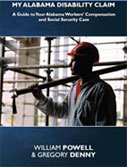
We Wrote the Book
My Alabama Disability Claim by William Powell & Gregory Denny Click Here to Get Your Free Copy


-
 5.0/5.0
A++++++ got results and staff is friendly
-
5.0/5.0
A++++++ got results and staff is friendly
-
5.0/5.0
Persevering for 2-3 years to get my disability. Thank You.
-
5.0/5.0
Persevering for 2-3 years to get my disability. Thank You.
-
 5.0/5.0
William Powell is an excellent attorney and a leader in our local bar.
