
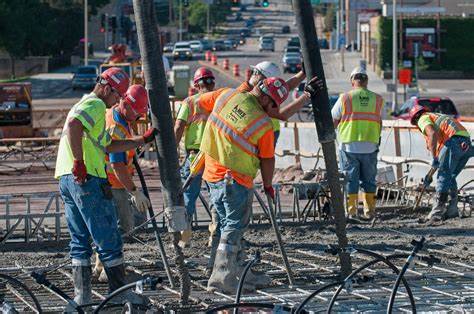
Why Are Alabama Construction Workers at High Risk for Serious Work Injuries?
Construction workers build the roads, homes, offices, factories, warehouses, hospitals, and other structures Alabama depends upon. But construction work also places employees around heights, heavy equipment, moving vehicles, electricity, trenches, power tools, falling materials, and constantly changing worksites.
The latest Alabama workplace-fatality statistics show just how serious those risks can be.
According to the U.S. Bureau of Labor Statistics, 75 workers died from occupational injuries in Alabama in 2024. Fourteen of those deaths occurred in the construction industry. Construction therefore accounted for approximately 19% of Alabama’s occupational fatalities that year. Nine of the 14 construction deaths occurred among specialty trade contractors. Bureau of Labor Statistics
The fatal occupational-injury rate for Alabama construction was 8.2 deaths per 100,000 full-time-equivalent workers in 2024, compared with an overall Alabama occupational-fatality rate of 3.6. Bureau of Labor Statistics
Those numbers are one reason we included construction among the industries discussed in our broader article, What Are the Most Dangerous Jobs in Alabama, but statistics alone do not explain why construction injuries can become so serious—or why determining the injured worker’s legal rights may involve much more than simply filing a workers’ compensation claim.
Why Is Construction Work So Dangerous?
A construction site is not a static workplace. The environment may change from one day to the next. Different subcontractors may be working simultaneously. Heavy equipment and delivery vehicles may move through the same areas where employees are working on foot. Openings, scaffolds, ladders, trenches, electrical systems, materials, tools, and unfinished structures can create hazards that do not exist in an ordinary office or retail workplace.
OSHA has traditionally identified four leading construction hazards: falls, struck-by hazards, electrical hazards, and caught-in/between hazards. Its construction guidance specifically includes construction vehicles and material-handling equipment among struck-by hazards. OSHA
Those categories also help explain why a construction accident can produce catastrophic injuries rather than relatively minor ones.
Falls Can Cause Life-Changing Injuries
Construction workers routinely perform tasks on:
roofs;
ladders;
scaffolds;
steel;
elevated platforms;
unfinished floors;
and other elevated surfaces.
A fall does not have to occur from a tremendous height to cause a serious injury. Depending upon how the worker lands, a construction fall can result in spinal fractures, herniated discs, shoulder injuries, knee injuries, traumatic brain injuries, fractures, or multiple injuries involving different parts of the body.
The 2024 Alabama fatality data reinforce the importance of fall hazards. Across all Alabama industries, falls, slips, and trips caused 14 occupational deaths, including 10 deaths from falls to a lower level. Bureau of Labor Statistics
For an injured construction worker, however, the legal question is not simply how far did you fall? It is also: What injuries did the fall cause, what permanent restrictions remain, and can you still perform construction work?
Construction Workers Can Be Struck by Equipment, Materials, and Vehicles
Construction sites also expose workers to moving equipment and materials. A worker may be struck by a falling object, suspended load, piece of equipment, forklift, crane component, dump truck, backing vehicle, or another object moving through the work area.
Across Alabama industries in 2024, BLS recorded 14 fatal contact incidents, including 10 deaths involving workers struck by propelled, falling, or suspended objects and four involving workers struck, caught, or compressed by running powered equipment. Bureau of Labor Statistics
The resulting injuries may include crush injuries, fractures, amputations, spinal injuries, traumatic brain injuries, or death. And when the equipment or vehicle that causes the injury belongs to someone other than the worker’s employer, another legal issue may arise: Does the worker have both a workers’ compensation claim and a claim against a third party?
We will return to that question below.
Caught-In and Caught-Between Accidents Can Be Catastrophic
Construction workers may also work around trenches, excavations, heavy machinery, structural components, moving equipment, and materials capable of trapping or crushing a person. A trench collapse is an obvious example, but caught-between injuries are not limited to excavation work.
A worker may be pinned between a vehicle and a wall, caught in machinery, trapped between pieces of equipment, or crushed by shifting materials. These accidents can result in devastating orthopedic injuries, internal injuries, amputations, or death.
Electrical Hazards Are Different From Many Other Construction Risks
Electricians are not the only construction workers exposed to electricity. Workers may encounter temporary wiring, overhead power lines, energized equipment, damaged cords, unfinished electrical systems, or equipment operating near electrical sources.
An electrical injury can cause burns and neurological injuries, but electrocution can also be fatal.
The important point is that construction workers frequently perform their jobs in environments where several different hazards overlap. A worker operating equipment, for example, may simultaneously face vehicle, electrical, fall, and struck-by risks.
Motor Vehicle Accidents Are Also Construction Accidents
One construction risk deserves more attention than it often receives: motor vehicle accidents.
Construction work does not always occur at a single fixed jobsite.
Workers may have to travel:
from one jobsite to another;
to obtain materials or parts;
to deliver equipment;
to inspect another location;
to attend meetings;
to transport coworkers;
to move company vehicles;
or to perform other assignments away from the primary jobsite.
Road and highway construction workers face an additional danger because their worksite itself may be surrounded by moving traffic.
This matters because transportation incidents are not a minor category of occupational fatalities in Alabama. In 2024, 32 of Alabama’s 75 fatal occupational injuries resulted from transportation incidents—approximately 43% of all occupational deaths in the state. Twenty of those deaths involved roadway incidents with motorized land vehicles. Bureau of Labor Statistics
A construction worker therefore does not have to fall from scaffolding or be injured by a power tool to suffer an on-the-job injury. The injury may happen on the highway.
Is a Motor Vehicle Accident Covered by Alabama Workers’ Compensation?
It can be.
Under Ala. Code § 25-5-51, an injury generally must result from an accident “arising out of and in the course of” employment to be compensable under Alabama’s Workers’ Compensation Act. Justia Law
That requirement becomes especially important when a construction worker is injured in an MVA.
If an employee is driving a company truck from one construction site to another as part of the workday and is injured in a collision, that presents a very different workers’ compensation question from an employee who has finished work and is simply driving home. The Alabama Court of Civil Appeals addressed a particularly useful example in McDaniel v. Helmerich & Payne International Drilling Co., 61 So. 3d 1091, 1093–96 (Ala. Civ. App. 2010).
McDaniel had traveled to Mobile County to help “rig down” an oil rig. The employer provided a crew trailer for its workers. The next morning, McDaniel contended that he attended a mandatory safety meeting at one worksite and was then traveling in his personal vehicle to another worksite when his vehicle collided with a tractor-trailer. The employer argued that McDaniel was merely on his way to work and therefore fell under Alabama’s general going-and-coming rule.
In reversing the summary judgment granted by the trial court, the Court of Civil Appeals explained that if McDaniel had already begun his workday and the journey from one worksite to the other was required by his employer, the accident could have arisen out of and in the course of his employment. Id. at 1095–96.
That principle can be extremely important for construction workers because their jobs frequently involve changing worksites.
What Is Alabama’s Going-and-Coming Rule?
As a general rule, an accident occurring while an employee is simply traveling to or from work is not considered to arise out of and in the course of employment, but that is the general rule, not the end of every travel case.
Alabama courts recognize circumstances in which travel can be part of the employment.
In McDaniel v. Helmerich & Payne International Drilling Co., the Court of Civil Appeals distinguished ordinary commuting from a journey undertaken during the workday as part of travel contemplated and required by the employer. Similarly, in Hospice Family Care v. Allen, 218 So. 3d 1222, 1232–35 (Ala. Civ. App. 2016), the Court explained that when an employer requires an employee to travel frequently by automobile in furtherance of the employer’s business, the travel itself can become part of the employment and the risk of an automobile accident can become an occupational hazard.
Although Allen involved a hospice employee rather than a construction worker, the legal principle is highly relevant to employees whose jobs require regular travel.
The actual circumstances of the trip matter.
Recommended Reading: What Should I Do After a Car Accident While Working?
Recommended Reading: Am I Covered by Workers Compensation While Traveling Out of Town for Work?
Recommended Reading: I Ran a Personal Errand When I Was Injured While Driving for Work—Am I Still Covered?
Recommended Reading: I Was Hurt Going to or Coming Home From Work—Is My Injury Covered by Alabama Workers Compensation?
What If Another Driver Causes the Construction Worker’s Accident?
This is where the Car Wreck and Workers’ Compensation claims can intersect directly. Suppose an electrician is driving from one Alabama jobsite to another at the direction of the employer. A negligent third-party driver runs a red light and crashes into the electrician’s work truck.
That single collision may potentially create two different claims: a workers’ compensation claim arising from the employment; and a third-party personal-injury claim against the negligent driver.
Alabama Code § 25-5-11 expressly contemplates this situation. When a compensable work injury is caused under circumstances creating legal liability in a third party, the employee may pursue workers’ compensation benefits and also bring an action against the third party.
That distinction is important because workers’ compensation and a third-party car-wreck claim are not the same legal remedy.
Workers’ Compensation and a Car Wreck Claim Pay Different Benefits
Alabama workers’ compensation can potentially provide benefits such as authorized medical treatment and disability benefits when the statutory requirements are satisfied, but workers’ compensation generally does not operate like an ordinary negligence claim against a third-party driver.
A third-party personal-injury claim may include damages that are not available in the same manner under workers’ compensation, including damages for pain and suffering and other compensatory losses recoverable under Alabama tort law. So, when a construction worker is hit by another driver while working, the legal analysis should not stop after someone says: “Workers’ comp is paying the medical bills.” There may also be a third-party MVA claim.
Recommended Reading: Can I Have Both a Workers Compensation Claim and a Personal Injury Claim?
What If the Construction Worker Is Hit by a Vehicle at the Jobsite?
The same basic issue can arise without anyone traveling between jobsites.
Imagine a highway construction worker struck by a passing motorist. Or a subcontractor’s employee struck by a delivery truck entering the site. Or a worker pinned by a vehicle operated by someone employed by a different company.
The fact that the injury happened at work does not necessarily mean workers’ compensation is the only possible claim.
The identity and legal relationship of the person or company responsible for the accident matter.
If the negligent party is legally a third party rather than the worker’s employer or another party protected by the Workers’ Compensation Act’s exclusivity provisions, § 25-5-11 may permit a separate tort action.
That can make the employment relationships on a large construction project extremely important.
Who Actually Employed the Injured Construction Worker?
Construction projects may involve many different companies working at the same location. There may be general contractors, subcontractors, temporary staffing companies, labor brokers, equipment companies, specialty contractors, and other businesses whose employees work alongside one another.
That can make the seemingly simple question “Who was your employer?” much more complicated than it sounds.
The answer can be especially important after a serious construction accident because Alabama’s Workers’ Compensation Act generally provides an employer with immunity from an employee’s ordinary tort claim for a compensable work injury.
If a company at the construction site is truly a third party, the injured worker may potentially have a separate personal-injury claim against that company under Ala. Code § 25-5-11.
But what if the worker technically receives a paycheck from one company while actually performing work for and taking instructions from another company?
That is where Alabama’s special-employer doctrine becomes important.
What Is a “Special Employer” Under Alabama Workers’ Compensation Law?
A worker can potentially have more than one employer for workers’ compensation purposes. The leading Alabama case is Terry v. Read Steel Products, 430 So. 2d 862, 865–66 (Ala. 1983).
Terry obtained a summer job through Manpower, Inc., an employment agency that supplied temporary workers to Read Steel Products. Although Terry was carried on Manpower’s payroll, he actually worked at Read Steel. While operating a machine there, his hand became caught in the machine and he was injured.
After receiving workers’ compensation benefits through Manpower, Terry attempted to pursue Read Steel as a third-party tortfeasor.
The Alabama Supreme Court therefore had to decide whether Read Steel was actually a third party or whether it was also Terry’s employer for purposes of Alabama’s Workers’ Compensation Act.
The Court adopted a three-part test for determining when a company becomes a worker’s special employer:
- The employee has entered into a contract of hire, either express or implied, with the special employer;
- The work being performed is essentially the work of the special employer; and
- The special employer has the right to control the details of the employee’s work.
Terry v. Read Steel Products, 430 So. 2d 862, 865 (Ala. 1983).
When all three requirements are satisfied, the worker can be considered an employee of both the general employer and the special employer for workers’ compensation purposes. Id. at 865–66.
That has an important consequence.
The special employer may receive the same workers’ compensation immunity from an ordinary negligence lawsuit that the worker’s direct employer receives.
In other words, a company does not necessarily become a legally responsible “third party” simply because its name is different from the company printed on the injured worker’s paycheck.
Why Is the “Contract of Hire” Requirement So Important?
Of the three Terry factors, the Alabama Supreme Court identified the contract-of-hire requirement as the most important criterion to scrutinize. Terry v. Read Steel Products, 430 So. 2d 862, 866 (Ala. 1983).
The contract does not necessarily have to be a formal written employment agreement directly between the worker and the special employer; it may be implied from the circumstances.
That makes facts such as these potentially important:
Who placed the worker at the jobsite?
Did the worker accept an assignment to work for the alleged special employer?
Who told the worker what job to perform?
Who supervised the worker?
Who controlled the details of the worker’s daily work?
Whose business was the worker actually performing?
How long did the worker perform work for that company?
Who ultimately funded the worker’s wages and workers’ compensation coverage?
Was a staffing or temporary-employment company acting primarily as a labor broker?
These questions can become particularly important on a construction site where a worker is hired through a temporary staffing company but spends every day taking instructions from a contractor at the project.
An Alabama Road-Construction Case Shows Why This Matters
The Alabama Supreme Court’s decision in Ex parte Midsouth Paving, Inc., 385 So. 3d 938 (Ala. 2023) provides an unusually good example of how the special-employer doctrine can affect an injured construction worker. Yvonne Mason worked through PeopleReady, a temporary-employment agency that supplied workers to Midsouth Paving. Mason accepted assignments working as a flagger at Midsouth’s road-paving jobsites.
PeopleReady issued Mason’s paychecks, but Midsouth employees directed and supervised her work at the jobsites.
While Mason was working at a Midsouth jobsite, a Midsouth employee was making a three-point turn in a pilot vehicle and accidentally struck her. Mason suffered a severe leg injury requiring multiple surgeries, hospitalization, and rehabilitation.
At first glance, the employment arrangement might suggest a straightforward division: PeopleReady was Mason’s employer, while Midsouth and the driver of the Midsouth vehicle were third parties.
If that were correct, Mason potentially could receive workers’ compensation benefits through PeopleReady while pursuing a separate negligence claim against Midsouth and its driver, but that was not the end of the analysis.
Midsouth argued that it was also Mason’s special employer under the test established in Terry.
There was little dispute over the second and third Terry requirements. Mason was performing Midsouth’s work, and Midsouth controlled the details of that work. The principal dispute involved the first requirement: Had Mason entered into an express or implied contract of hire with Midsouth?
In determining whether such an implied employment relationship existed, the Alabama Supreme Court examined the actual circumstances surrounding Mason’s work.
Among other things, the Court considered the nature of PeopleReady’s role as a temporary-employment agency or labor broker, Mason’s acceptance of assignments to Midsouth jobsites, the duration and circumstances of her relationship with Midsouth, Midsouth’s control over her work, and the manner in which workers’ compensation coverage was funded.
The insurance arrangement was particularly significant.
Midsouth paid PeopleReady an amount that included Mason’s wages plus an additional charge that covered, among other expenses, workers’ compensation insurance, and Midsouth was an alternate insured under PeopleReady’s workers’ compensation policy.
After considering the Terry factors, the Alabama Supreme Court concluded that Mason was Midsouth’s special employee. Ex parte Midsouth Paving, Inc., 385 So. 3d 938 (Ala. 2023).
That conclusion dramatically affected what claims Mason could pursue.
Because Midsouth was her special employer rather than an ordinary third party, Alabama’s workers’ compensation exclusivity provisions barred her ordinary tort claims against Midsouth. Her ordinary negligence claim against the Midsouth employee who struck her was likewise barred; a tort action against a co-employee under § 25-5-11 requires the statutorily specified type of willful conduct, not merely negligence.
Why Does the Special-Employer Doctrine Matter After a Construction Accident?
Consider a construction worker supplied by a staffing company to work on a large highway project. The staffing company issues the worker’s paycheck, but another contractor:
assigns the worker’s duties;
controls the jobsite;
tells the worker when and where to work;
supervises the worker;
and controls how the work is performed.
Now suppose one of that contractor’s vehicles backs into the worker and causes a serious injury.
It would be tempting to conclude: “The staffing company is my employer, so I have a workers’ compensation claim against it and a separate MVA or personal-injury claim against the contractor.”
That may be true in some circumstances, but it is not automatically true.
Before treating the contractor as a third-party defendant, the Terry factors have to be considered. If the contractor qualifies as the worker’s special employer, workers’ compensation exclusivity may prevent an ordinary negligence action against that contractor.
Midsouth Paving demonstrates that this is not merely a theoretical distinction.
The Name on the Paycheck Does Not Necessarily Answer the Question
This is why identifying potential third-party claims after a serious construction accident requires more than making a list of companies at the jobsite. The investigation may need to determine:
Who was the worker’s general employer?
Was there also a special employer?
Did the worker expressly or impliedly consent to that employment relationship?
Whose work was actually being performed?
Who had the right to control the details of the work?
Who supervised the worker on the jobsite?
Who provided or funded workers’ compensation coverage?
Was the company that caused the injury actually a third party—or was it another employer protected by workers’ compensation exclusivity?
Those questions can determine whether the injured construction worker has only a workers’ compensation remedy against a particular company or may also pursue that company in a separate personal-injury action.
And once we identify the worker’s employer or employers, there is another important question: Did someone outside that employment relationship contribute to the construction accident?
What If Defective Equipment or Another Contractor Causes the Injury?
A third-party claim is not limited to motor vehicle accidents. A construction worker may receive workers’ compensation from the employer while potentially having a separate claim against another legally responsible party.
Depending upon the facts, that might involve:
a different contractor;
an equipment manufacturer;
a property owner;
a delivery company;
a motorist;
or another entity that is not protected by the employer’s workers’ compensation immunity.
Section 25-5-11 is therefore an important statute in serious construction-injury cases because it expressly recognizes circumstances in which the work injury also creates legal liability in someone other than the employer, but identifying a company as a “third party” requires legal analysis. On a multi-employer construction project, the special-employer doctrine and other provisions of Alabama workers’ compensation law may affect whether a tort claim is available.
Does Workers’ Compensation Have to Be Paid Back From a Third-Party Settlement?
This is another reason the two claims should be handled together rather than independently. Alabama Code § 25-5-11 contains reimbursement, credit, and subrogation provisions that can affect the relationship between a third-party recovery and workers’ compensation benefits.
A particularly relevant Alabama case actually involved a construction company.
In Ex parte BE&K Construction Co., 728 So. 2d 621, 622–25 (Ala. 1998), an employee pursued workers’ compensation benefits from BE&K while also pursuing a third-party tort claim arising from the same incident. The Alabama Supreme Court addressed the employer’s subrogation rights under § 25-5-11, including the treatment of medical expenses associated with the third-party recovery.
The precise reimbursement calculation can become complicated, particularly when medical benefits, future medical treatment, attorney fees, and the allocation of a third-party recovery are involved.
The important practical point is: Do not settle the third-party claim as though the workers’ compensation claim does not exist.
The two claims can affect one another.
Recommended Reading: Will I Have to Pay Workers Compensation Back If I Settle a Related Personal Injury Claim?
Recommended Reading: Can I Settle a Personal Injury Claim Without Telling Workers Compensation?
What Benefits Can an Injured Alabama Construction Worker Receive?
If the accident is covered by Alabama’s Workers’ Compensation Act, available benefits depend upon the particular injury and its consequences. Those may include authorized medical treatment and disability benefits.
But in a serious construction case, one of the most important questions often comes later: Can the worker return to construction work?
Construction work can be physically demanding. A worker may have to climb, lift, carry, bend, stoop, kneel, crouch, work overhead, maintain balance, tolerate vibration, use tools, or remain on his or her feet for much of the day. A permanent restriction can therefore have very different vocational consequences for a construction laborer than it would have for someone performing sedentary office work.
What If the Doctor Says I Can Work, but I Cannot Do My Old Construction Job?
This distinction matters.
A physician may release an injured worker with permanent restrictions such as:
no lifting over 20 pounds;
no repetitive bending;
no climbing;
no work at unprotected heights;
limited standing or walking;
no kneeling or squatting;
or restrictions on use of an injured arm or hand.
The worker may technically possess some capacity to work while being unable to return to the occupation he or she has performed for years. That can make vocational disability an important issue in an Alabama workers’ compensation case involving a nonscheduled injury.
The analysis may involve the worker’s age, education, work history, transferable skills, physical restrictions, pain, and ability to obtain and maintain suitable employment. That is why the consequences of a construction injury should not necessarily be measured solely by an impairment percentage written in a medical report.
What If I Had Back, Knee, or Shoulder Problems Before the Construction Accident?
Construction workers frequently have histories of orthopedic problems because the work itself can be physically demanding. A prior back problem, knee injury, shoulder condition, or previous surgery does not automatically mean a later work injury is not compensable.
The important questions include the worker’s condition before the accident, the ability to perform the job before the accident, what happened in the new accident, and whether the work accident caused or aggravated the condition for which benefits are being sought.
Medical records, testimony concerning the worker’s pre-accident abilities, diagnostic testing, and medical opinions may all become important.
This same causation problem appears frequently in car-wreck cases, which is why our next article in this series will examine it from the MVA side: What If I Had a Preexisting Injury Before My Alabama Car Wreck?
Recommended reading: Did My Work Accident Cause a New Injury, an Aggravation or Exacerbation of an earlier injury or Just a Recurrence? Understanding Preexisting Conditions in Alabama Workers Compensation Cases
What If a Construction Injury Prevents Me From Working Permanently?
Some construction injuries have consequences that extend far beyond the immediate workers’ compensation claim.
A worker who has spent decades performing heavy or skilled physical labor may suffer permanent restrictions that prevent a return not only to the former construction job but to other jobs the worker has performed in the past.
That may make vocational evidence particularly important in the workers’ compensation case.
And in sufficiently severe, long-term cases, the worker may also need to investigate whether he or she qualifies for Social Security Disability Insurance.
Workers’ compensation disability and Social Security disability are different legal standards. A finding under one system does not automatically determine the result under the other, but the same functional restrictions that prevent a construction worker from returning to heavy physical employment may become important evidence in both systems.
Recommended reading: What Happens If I Can’t Return to My Job After a Work Injury? Workers Compensation and Social Security Disability Explained
What If a Construction Worker Is Killed on the Job?
Alabama’s Workers’ Compensation Act provides death benefits under qualifying circumstances when an employee dies as a result of a compensable work accident, but a fatal construction accident may also require investigation into potential third-party liability.
For example, a worker may be killed by a negligent third-party driver, defective equipment, or conduct attributable to another legally responsible entity.
Section 25-5-11 specifically addresses injuries or deaths caused under circumstances also creating liability in a third party. So once again, the correct legal analysis may require looking at both sides of the case: Workers’ Compensation + Third-Party Liability rather than assuming that one necessarily eliminates the other.
A Construction Accident May Involve More Than One Area of Law
A serious Alabama construction accident can present several legal questions at the same time.
A worker who falls from scaffolding may primarily have a workers’ compensation claim.
A worker injured by equipment owned by another company may have a workers’ compensation claim and a potential third-party claim.
A construction worker hit by a negligent motorist while traveling between jobsites may have both a workers’ compensation claim and an personal injury claim.
And a worker who cannot return to construction because of permanent injuries may eventually have issues involving vocational disability or Social Security Disability.
That is why serious construction accidents should be analyzed according to what actually happened and who may be legally responsible, rather than simply being labeled “a workers’ comp case.”
The Bottom Line
Construction remains one of Alabama’s most hazardous industries. In 2024, 14 Alabama construction workers died from occupational injuries, and the industry’s fatality rate of 8.2 deaths per 100,000 full-time-equivalent workers was more than twice Alabama’s overall occupational-fatality rate of 3.6. Bureau of Labor Statistics
Construction workers face obvious dangers from heights, heavy equipment, falling materials, machinery, trenches, and electricity, but they also face another major occupational hazard: motor vehicles.
Workers travel between jobsites. They haul tools and materials. They drive company trucks. They work alongside highways. They encounter delivery vehicles and heavy equipment at jobsites.
When a construction worker is injured in an MVA while performing job duties, the collision may be covered by workers’ compensation. When another driver or legally responsible third party caused the wreck, the worker may also have a separate personal-injury claim.
Those claims can coexist—but they can also affect one another.
At Powell & Denny, P.C., we have handled workers’ compensation and disability claims involving serious injuries and the long-term inability to work. When a work injury also involves a motor vehicle accident or another potentially responsible third party, identifying all of the available claims can be just as important as proving the injury itself.
If you or a loved one suffered a serious on-the-job injury and you have questions about your rights- — don’t hesitate to contact and speak with one of the experienced attorneys at Powell and Denny today for a free consultation. Appointments are available in person, or virtually via Zoom if more convenient. Powell and Denny would appreciate the opportunity to help. And remember, there is no fee unless you win.
Powell & Denny: We Work When You Can’t.
Recommended Reading:
What Are the Most Dangerous Jobs in Alabama?
What If I Was Injured While Riding as a Passenger for Work?
Does an Employee’s Failure to Wear a Seat Belt Bar Alabama Workers Compensation Benefits?
We Wrote the Book
My Alabama Disability Claim by William Powell & Gregory Denny Click Here to Get Your Free Copy


-
 5.0/5.0
A++++++ got results and staff is friendly
-
5.0/5.0
A++++++ got results and staff is friendly
-
5.0/5.0
Persevering for 2-3 years to get my disability. Thank You.
-
5.0/5.0
Persevering for 2-3 years to get my disability. Thank You.
-
 5.0/5.0
William Powell is an excellent attorney and a leader in our local bar.
