
Can I Have Both a Workers Compensation Claim and a Personal Injury Claim?
Many Alabama Workers Injured on the Job May Have Two Separate Legal Claims
You were hurt while working. Maybe another driver ran a red light. Perhaps a forklift operated by another company struck you. Maybe defective equipment failed or another contractor’s negligence caused your injury.
Your employer tells you to report the injury to workers’ compensation.
Someone else tells you to sue.
Another person insists you cannot sue because the accident happened while you were working.
So who is right?
The Quick Answer
If you were injured on the job because someone other than your employer caused the accident, you may have both:
- a workers’ compensation claim against your employer or its workers’ compensation insurance carrier; and
- a personal injury claim against the negligent person or company that caused your injuries.
These are two separate legal claims.
They involve different laws, different insurance companies, different types of compensation, and different strategic considerations.
One Accident Can Create Two Separate Claims
Many injured workers assume that because they were hurt while working, workers’ compensation is their only remedy. That is not always true.
Workers’ compensation exists to provide medical treatment and disability benefits to employees who suffer compensable job-related injuries.
Personal injury law serves a different purpose. It allows an injured person to recover damages from the person or company whose negligence caused the injury.
Sometimes both systems apply to the same accident. When they do, an injured worker may be able to pursue both claims.
A Common Example
Suppose a home health nurse is driving to see a patient. Another driver crosses the centerline and causes a serious collision. The nurse suffers multiple fractures and cannot return to work for several months.
The nurse may have a workers’ compensation claim because she was performing her job duties when injured.
She may also have a personal injury claim against the negligent driver.
One accident.
Two claims.
Who Is the “Third Party”?
Many people think the third party is always another driver. Not necessarily.
A third party is generally a person or company other than the employer whose negligence caused or contributed to the injury.
Examples may include another motorist, a trucking company, another contractor on a construction site, a manufacturer of defective equipment, or a property owner responsible for a dangerous condition.
That is why a serious job-related injury should often be examined from two directions:
Was this covered by workers’ compensation?
and
Did someone else cause it?
Automobile Accidents
This is probably the most common example.
Delivery drivers, home health nurses, sales representatives, construction supervisors, service technicians, utility workers, and many other employees spend part of their workday driving.
If another driver’s negligence causes a collision while the employee is engaged in work-related duties, the employee may have both a workers’ compensation claim and a personal injury claim against the negligent driver.
Recommended Reading: I Was Hit by Another Driver While Working—Do I Have a Workers’ Compensation Claim and a Car Accident Claim?
Construction Accidents
Construction projects often involve multiple companies working at the same location.
Suppose an employee of one subcontractor is injured because another subcontractor negligently operates heavy equipment.
The injured employee may receive workers’ compensation benefits through his own employer while also pursuing a negligence claim against the responsible third party.
Defective Equipment
Suppose a piece of industrial machinery fails because of a defect and seriously injures an employee.
Workers’ compensation may cover the job injury.
A separate product liability claim may also exist against a manufacturer or other legally responsible party.
Dangerous Property Conditions
An employee may be injured while making a delivery, visiting a customer, or performing work at someone else’s property.
If a dangerous condition caused the injury, the employee may have workers’ compensation rights and a separate premises liability claim.
Do I Have to Choose Between the Two?
Usually, no.
This is one of the biggest misconceptions injured workers have. Receiving workers’ compensation benefits does not automatically eliminate a separate claim against a negligent third party.
Alabama law specifically recognizes third-party actions in appropriate cases.
Why Can’t I Usually Sue My Employer?
Workers’ compensation generally becomes the employee’s exclusive remedy against the employer for ordinary negligence arising out of a covered job-related injury. That is part of the basic workers’ compensation bargain.
The employee generally receives statutory benefits without having to prove negligence. In exchange, the employer is generally protected from an ordinary negligence lawsuit arising from the same injury.
That protection, however, does not ordinarily extend to unrelated third parties whose negligence caused the accident.
Recommended Reading: Can I Sue My Employer for a Job-Related Injury? Understanding Alabama’s Workers’ Compensation Exclusive Remedy Rule.
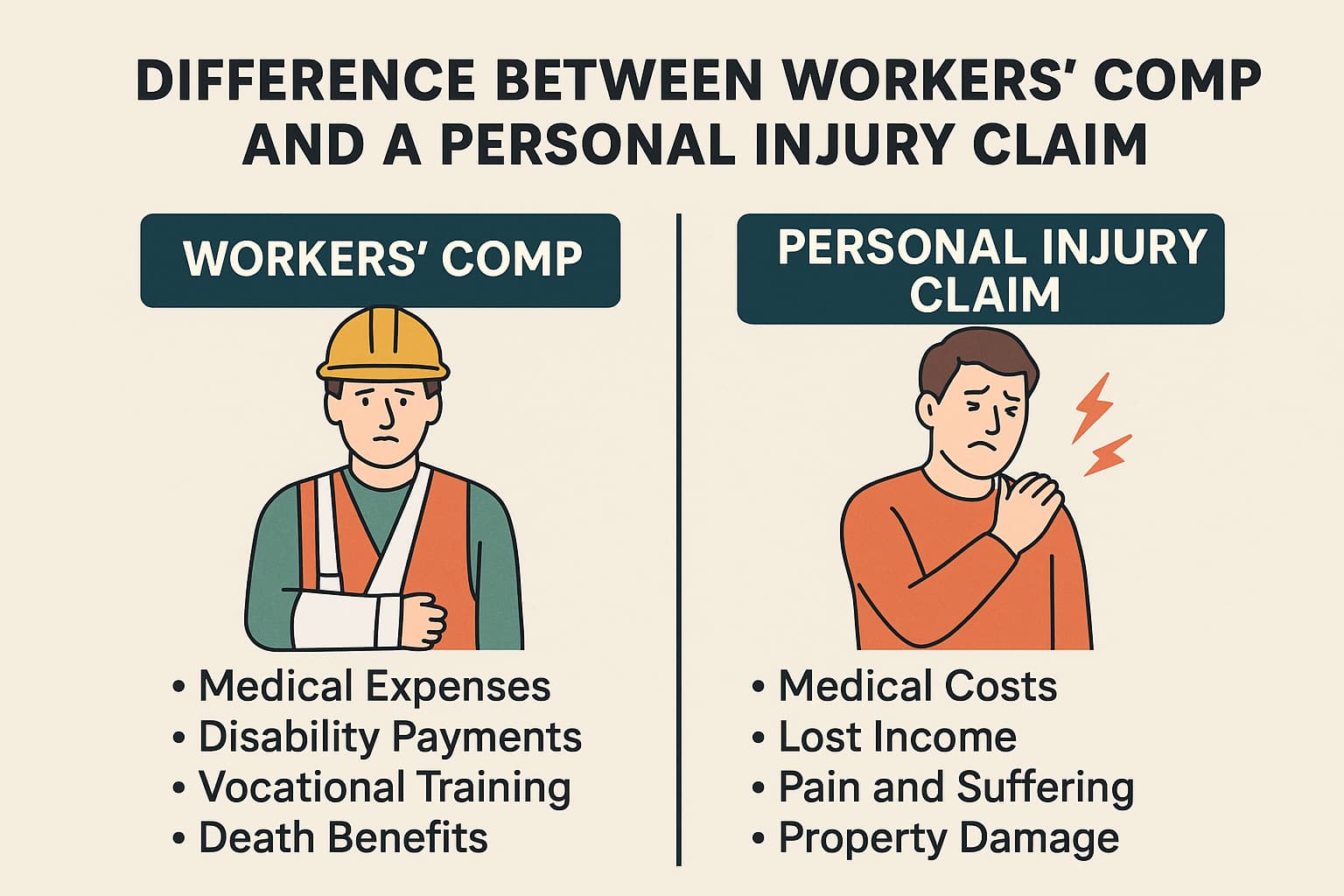
Workers’ Compensation and Personal Injury Do Not Pay the Same Damages
Workers’ compensation generally provides benefits such as authorized medical treatment, temporary disability benefits, permanent disability benefits, and other statutory benefits.
A personal injury claim may include damages that workers’ compensation generally does not provide, including pain and suffering, mental anguish, loss of enjoyment of life, future medical expenses, loss of earning capacity, and other damages allowed by Alabama law.
That difference is important.
An injured worker should not assume that workers’ compensation fully replaces a personal injury claim when another party caused the accident.
What About Pain and Suffering?
Workers’ compensation generally does not compensate an injured worker for pain and suffering in the same way a personal injury claim does.
That is one of the biggest differences between the two systems.
A third-party personal injury claim may allow recovery for harms that are simply not part of the workers’ compensation benefit structure.
Recommended Reading: Am I Entitled to Money for Pain and Suffering in an Alabama Workers Compensation Claim?
Can Workers’ Compensation Continue While the Personal Injury Case Is Pending?
Yes, in appropriate cases.
The two matters may proceed at the same time.
Workers’ compensation may pay medical expenses and disability benefits while the third-party case is being investigated, negotiated, or litigated.
That can be especially important because serious personal injury cases sometimes take much longer to resolve.
What Is Subrogation?
This is one of the most important issues when both claims exist. Suppose workers’ compensation pays medical expenses and disability benefits. Later, the injured worker recovers money from the negligent third party.
Under § 25-5-11, Ala. Code 1975, the workers’ compensation carrier may have reimbursement or subrogation rights with respect to certain benefits it has paid.
That can affect how much of the third-party recovery the injured worker ultimately keeps.
Subrogation can become complicated because questions may arise involving attorney’s fees, litigation expenses, future medical expenses, settlement allocation, and other issues.
One Case Can Affect the Other
Although the claims are legally distinct, they often overlap in important ways.
Medical opinions developed in one case may matter in the other.
Depositions may be used in both.
Statements about how the accident occurred may affect both claims.
Settlement of one claim may affect the economics or strategy of the other.
For that reason, the two claims should usually be evaluated together rather than as completely unrelated matters.
Common Mistakes
Some common mistakes include assuming workers’ compensation is the only available remedy, failing to identify a negligent third party, giving unnecessary recorded statements, failing to preserve photographs or witness information, misunderstanding subrogation, and settling one claim without considering the effect on the other.
The Law
- 25-5-11, Ala. Code 1975 allows an injured employee, in appropriate circumstances, to pursue a claim against a third party legally responsible for the injury while also receiving workers’ compensation benefits.
- 25-5-53, Ala. Code 1975 generally provides that workers’ compensation is the exclusive remedy against the employer for covered job-related injuries, subject to recognized exceptions.
Whether a third-party claim exists depends upon the facts of the accident, the identity of the responsible party, and the application of Alabama tort law together with the Workers’ Compensation Act.
The Bottom Line
If someone other than your employer caused your job-related injury, you may have more than one legal claim.
Many Alabama workers may pursue both workers’ compensation benefits and a separate personal injury claim arising from the same accident.
The key is identifying every potentially responsible party early and understanding how the claims interact before important rights are lost.
At Powell & Denny, P.C., we have extensive experience representing injured workers in Alabama workers’ compensation claims and related third-party personal injury claims. When the same accident creates both claims, it is important to understand how they work together. Medical evidence, settlement decisions, workers’ compensation subrogation rights, and other issues in one claim can directly affect the other. Our experience handling both workers’ compensation and personal injury cases allows us to evaluate the entire case—not just one part of it—and work to protect all of the benefits and compensation available to our clients.
If you believe you have a workers compensation and also a personal injury claim against another party-don’t hesitate to contact and speak with one of the experienced attorneys at Powell and Denny today for a free consultation. Appointments are available in person, or virtually via Zoom if more convenient. Powell and Denny would appreciate the opportunity to help. And remember, there is no fee unless you win.
We Wrote the Book
My Alabama Disability Claim by William Powell & Gregory Denny Click Here to Get Your Free Copy


-
 5.0/5.0
A++++++ got results and staff is friendly
-
5.0/5.0
A++++++ got results and staff is friendly
-
5.0/5.0
Persevering for 2-3 years to get my disability. Thank You.
-
5.0/5.0
Persevering for 2-3 years to get my disability. Thank You.
-
 5.0/5.0
William Powell is an excellent attorney and a leader in our local bar.
