
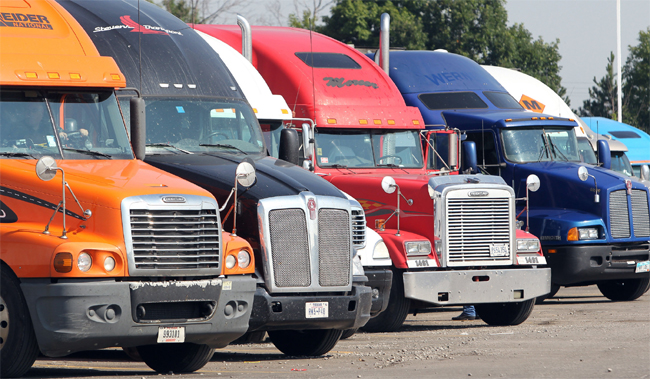
I Was Injured While Working as a Truck Driver in Alabama. Can I Get Workers’ Compensation?
Professional truck driving is much more than sitting behind a steering wheel. Truck drivers climb in and out of cabs and trailers. They inspect equipment. They secure and unsecure loads. They move tandems. They connect and disconnect trailers. They may lift freight, use chains and binders, work around loading docks, and make deliveries in unfamiliar locations. And, of course, they spend much of their working lives on the highway.
All of that can make truck driving a dangerous occupation.
The most recent Bureau of Labor Statistics data show that heavy and tractor-trailer truck drivers accounted for 18 fatal occupational injuries in Alabama in 2024. Transportation and material-moving occupations accounted for 25 worker deaths, more than any other major occupational group reported for Alabama.
But a truck driver does not have to be involved in a catastrophic highway wreck to suffer a serious job injury.
If you are a truck driver who was hurt while working, several questions may determine whether you are entitled to Alabama workers’ compensation benefits.
Are Truck Drivers Covered by Alabama Workers’ Compensation?
Many truck drivers who are employees are covered by Alabama’s Workers’ Compensation Act when they suffer an injury arising out of and in the course of their employment. That can include much more than an accident that occurs while actually driving the truck. Depending upon the circumstances, a compensable accident may occur while a driver is:
- driving a tractor-trailer or other commercial vehicle;
- loading or unloading;
- securing or un-securing cargo;
- performing a pre-trip or post-trip inspection;
- connecting or disconnecting a trailer;
- moving equipment;
- climbing into or out of the cab or trailer;
- making a delivery;
- performing roadside work;
- staying away from home while on an assigned trip; or
- performing another activity required by the driver’s employment.
The central issue is generally the relationship between the accident and the employment—not simply whether the truck was moving when the injury occurred.
Recommended Reading: What Does It Mean for an Injury to “Arise Out of and Occur in the Ordinary Course of Employment”?
Truck Drivers Face More Than Highway Accidents
Motor vehicle collisions are an obvious danger for professional drivers, but they are only part of the problem; a professional driver’s physical job duties create additional risks.
We have seen truck-driver claims involving injuries to the back, neck, shoulders, knees, hands, feet, and other parts of the body. A driver can be injured when a load shifts, a chain or binder gives way, equipment malfunctions, the driver falls from a trailer, or heavy cargo must be moved.
That distinction matters because a serious truck-driver injury is not somehow less of a work injury simply because there was no highway collision.
Recommended Reading: What Are the Most Dangerous Jobs in Alabama?
What If I Am Injured in a Wreck While Driving for Work?
A truck driver injured in a collision while performing his or her job may have an Alabama workers’ compensation claim-but that may not be the only claim.
Suppose another driver runs a red light and crashes into your tractor-trailer while you are making a delivery. The accident potentially creates two separate legal claims.
Workers’ compensation claim: Your employment may entitle you to workers’ compensation benefits regardless of whether the other motorist was negligent.
Third-party personal injury claim: If another driver negligently caused the collision, you may also have a personal injury claim against that driver.
The two claims involve different legal rules and potentially different benefits and damages. They can also interact with one another. If workers’ compensation pays benefits and the injured employee later recovers money from the negligent third party, Alabama law contains provisions addressing the workers’ compensation carrier’s potential right to reimbursement.
That makes work-related motor vehicle accidents considerably more complicated than ordinary car-wreck cases.
Recommended Readings: What Should I Do After a Car Accident While Working?
Can I Have Both a Workers Compensation Claim and a Personal Injury Claim?
Will I Have to Pay Workers Compensation Back If I Settle a Related Personal Injury Claim?
What If the Other Driver Does Not Have Insurance?
A work-related wreck can become even more complicated when the negligent driver has no liability insurance or does not have enough insurance to pay for the injuries caused. Depending upon the facts and the available insurance policies, uninsured or underinsured motorist coverage may become important.
But UM/UIM coverage raises its own questions: Who qualifies as an insured? Which vehicle was involved? Whose policy applies? Are multiple coverages available? Can coverage be stacked? Is the injured employee legally entitled to recover from the other driver?
Those issues should be investigated before releases are signed or claims are resolved.
Recommended Reading: What Is Uninsured and Underinsured Motorist Coverage in Alabama?
What If the Driver Who Hit Me Doesn’t Have Enough Insurance to Pay for My Injuries?
What If I Am Injured Outside Alabama?
This is one of the most important issues for over-the-road drivers. A truck driver’s home may be in Alabama, the trucking company’s terminal may be somewhere else, and the driver may be injured hundreds of miles from either one.
An injury occurring outside Alabama does not automatically mean Alabama workers’ compensation law cannot apply. Alabama Code § 25-5-35 addresses circumstances in which Alabama workers’ compensation benefits may be available for an accident occurring outside the state. Among other things, the statute considers where the employment is principally localized and, in certain situations, where the contract of hire was made.
Alabama appellate decisions demonstrate how important those questions can be for interstate workers.
In Jenkins v. American Transport, Inc., 195 So. 3d 996 (Ala. Civ. App. 2015), a professional truck driver sought Alabama workers’ compensation benefits after suffering severe injuries in Minnesota while unchaining cargo he had transported from Colorado.
Although the accident occurred in Minnesota, the evidence showed that Jenkins picked up and delivered loads in numerous states and that his employment was not principally localized in any one state. Jenkins had also signed his agreement with the trucking company in Alabama.
The Alabama Court of Civil Appeals held that Jenkins’s signing of the agreement in Alabama constituted substantial evidence that his contract of hire was made in Alabama. Therefore, if Jenkins was an employee rather than an independent contractor and his contract of hire was made in Alabama, he could be entitled to Alabama workers’ compensation benefits under Ala. Code § 25-5-35(d)(2) even though his accident occurred in Minnesota. The court reversed the summary judgment entered against Jenkins and sent the case back for further proceedings.
For an over-the-road truck driver, therefore, the state where the accident occurred does not necessarily determine which state’s workers’ compensation law may apply. Where the employment is principally localized, where the contract of hire was made, and the driver’s actual employment relationship can all matter.
What If I Work for an Out-of-State Trucking Company but Am Injured in Alabama?
The reverse situation can also occur.
A truck driver may work for a company based elsewhere and have employment principally localized in another state but suffer an accident while traveling through Alabama. Alabama Code § 25-5-35(g) addresses certain injuries occurring inside Alabama even when the employee’s employment is principally localized in another state.
Alabama appellate decisions have considered this issue in truck-driver cases. In Morgan v. CLM Industries, for example, the Alabama Court of Civil Appeals concluded that an Alabama court could consider a workers’ compensation claim involving a truck driver whose employment was principally localized in Texas because the injury occurred in Alabama.
For an interstate truck driver, determining which state’s workers’ compensation law applies can therefore require much more than looking at the location of the trucking company’s headquarters.
What If the Trucking Company Calls Me an Independent Contractor?
This can be one of the most complicated issues in a truck-driver workers’ compensation claim.
Some drivers are unquestionably employees. Others are true independent contractors. Still others work under agreements describing them as independent contractors even though the actual relationship may be more complicated. A contractual label does not necessarily answer every employment-status question.
Some drivers are unquestionably employees. Others are true independent contractors. Still others work under lease agreements or contracts describing them as independent contractors even though the actual working relationship may tell a different story.
A contractual label does not necessarily answer the employment-status question.
The Alabama Supreme Court addressed this issue in Ex parte Curry, 607 So. 2d 230 (Ala. 1992). Curry was a truck driver who was seriously injured in a motor vehicle accident while hauling a load for Interstate Express. Interstate contended that Curry was an independent contractor and therefore was not entitled to workers’ compensation benefits.
The Alabama Supreme Court explained that the central inquiry is the alleged employer’s right of control. Importantly, the question is not limited to how much control the company actually exercised on a particular day. The Court stated that it is ultimately the reserved right of control that determines the issue.
The Court considered four factors that can demonstrate a right of control:
- direct evidence of the right or exercise of control;
- the method by which the worker is paid;
- whether the alleged employer furnishes equipment; and
- whether the worker has the right to terminate the relationship.
The actual facts of Curry’s trucking arrangement are particularly instructive.
Interstate controlled which loads Curry picked up, where he picked them up, where he delivered them, and how the loads were to be handled. On the day of Curry’s accident, he was hauling dog food from Chicago to Jacksonville. Curry was concerned that the cargo had not been properly secured and contacted Interstate about it. Interstate instructed him to be careful but to continue transporting the load to its destination.
Interstate also controlled important aspects of Curry’s compensation. Interstate booked the hauling contracts and assigned the loads to Curry. After Interstate received payment, it paid Curry 78 percent of the proceeds, less certain expenses, while Interstate retained 22 percent.
The company also furnished significant equipment and items necessary to perform the work. In addition to the truck arrangement involved in the case, Interstate provided items including fuel and mileage taxes, permits, liability insurance, cargo insurance, and bobtail insurance. The parties’ lease agreement also provided for termination upon 30 days’ written notice.
After examining those facts, the Alabama Supreme Court concluded that no reasonable view of the evidence supported the trial court’s finding that Curry was an independent contractor. The Court held that Curry was an employee of Interstate for purposes of Alabama’s Workers’ Compensation Act and reversed the judgment denying his claim.
Curry illustrates an important point for injured truck drivers:
The existence of a lease agreement, percentage-based compensation, or an “independent contractor” label does not necessarily determine whether a driver is an employee under Alabama workers’ compensation law.
The actual relationship matters, including who has the right to control the work, how the driver is paid, who provides equipment and necessary operating items, and how the relationship may be terminated.
Is There a Special Alabama Rule for Owner-Operators and Leased Operators?
Yes.
The ordinary right-of-control test discussed in Curry does not necessarily decide the issue when the case involves a common motor carrier and an owner-operator or leased operator.
Alabama Code § 25-5-1(4) contains a specific statutory provision addressing this situation. It provides that a common carrier by motor vehicle operating pursuant to a certificate of public convenience and necessity shall not be deemed the employer of a leased operator or owner-operator of a motor vehicle under contract to the common carrier.
That can make a significant difference in a truck driver’s workers’ compensation claim.
The Alabama Court of Civil Appeals addressed this provision in Alaplex Transportation, Inc. v. Rossen, 836 So. 2d 901 (Ala. Civ. App. 2002). The facts of Alaplex are important.
Alaplex was a common motor carrier. It leased trucks from R.P. Gray, an independent owner-operator. Gray hired Rossen to drive one of those trucks. At first glance, some of the evidence looked very much like the type of evidence that might establish an employer-employee relationship under the right-of-control analysis discussed in Curry.
Alaplex’s dispatchers told Rossen which shipments to pick up and deliver. Rossen was expected to contact Alaplex when problems arose. He was required to comply with Alaplex’s procedures, and Alaplex conducted driver meetings. The lease also gave Alaplex exclusive possession, control, and use of Gray’s equipment during the term of the agreement.
The trial court relied upon the relationship between Alaplex and Rossen in finding that Rossen was an employee of Alaplex.
The Alabama Court of Civil Appeals reversed.
The reason was § 25-5-1(4).
The Court of Civil Appeals explained that the Alabama Legislature had created a specific statutory exclusion for this type of common-carrier relationship. When the statutory provision applies, a qualifying common carrier cannot be treated as the workers’ compensation employer of an owner-operator or leased operator whose vehicle is under contract to the carrier.
The court concluded that, in this particular situation, the Legislature had “unequivocally foreclosed consideration of other factors” that might ordinarily indicate the existence of an employer-employee relationship.
That is an important distinction from Curry.
Curry teaches that simply calling a truck driver an independent contractor does not necessarily make the driver one. The actual relationship—and particularly the reserved right of control—must ordinarily be examined.
Alaplex teaches that before applying that ordinary analysis, you must determine whether Alabama’s specific common-carrier provision applies. If § 25-5-1(4) applies, evidence of control that might otherwise support an employer-employee relationship cannot simply be used to make the qualifying common carrier the driver’s workers’ compensation employer.
There was another important fact in Alaplex: Rossen did not own the truck.
Gray owned the truck and hired Rossen to drive it. Rossen argued that the statutory provision should not prevent him from being considered Alaplex’s employee because he was not himself the owner-operator. The Court of Civil Appeals rejected that argument. It concluded that the statutory exclusion could not be avoided merely because the owner-operator delegated the actual driving of the leased vehicle to another driver.
The distinction also appeared in Jenkins v. American Transport, Inc., 195 So. 3d 996 (Ala. Civ. App. 2015). The Court of Civil Appeals recognized that § 25-5-1(4) might potentially have applied to the owner-operator arrangement in that case. However, in this case, the trucking company had not asserted the statutory exemption as a defense, so the court would not rely upon that un-pleaded defense as a basis for affirming the judgment against Jenkins.
These cases demonstrate why determining a truck driver’s workers’ compensation employer can require more than simply asking: “Who controlled my work?”
The analysis may first require asking: Does Alabama’s special common-carrier provision apply to this relationship?
If it does not, the ordinary employment analysis illustrated by Curry may become critical.
If it does, § 25-5-1(4) may prevent the common carrier from being treated as the driver’s workers’ compensation employer despite evidence of control that might otherwise support an employment relationship.
If the Common Carrier Is Not My Employer, Does That Mean I Have No Workers’ Compensation Claim?
Not necessarily.
The fact that § 25-5-1(4) may prevent a particular common carrier from being treated as the driver’s employer does not necessarily answer whether the driver has a workers’ compensation claim against someone else.
The next question may be:
Who actually employed the driver?
Alaplex itself illustrates why that question matters. Gray owned the truck and hired Rossen to drive it. The court concluded that the statutory provision prevented Alaplex from being treated as Rossen’s employer under the Workers’ Compensation Act. Unfortunately for Rossen, Gray had not obtained workers’ compensation insurance covering him. Rossen did have a separate occupational accident insurance policy, which had paid medical expenses and temporary disability benefits, but that was not the same thing as establishing workers’ compensation liability against Alaplex.
An injured truck driver therefore should not assume that being called an “independent contractor,” driving an owner-operator’s truck, or working under a lease arrangement automatically determines whether workers’ compensation benefits are available.
The relationships among the driver, owner-operator, motor carrier, and any other employing entity may need to be examined, along with the applicable insurance coverage.
For an injured truck driver, the real question may not simply be: “Am I an employee?”
It may be: “Whose employee am I for purposes of Alabama workers’ compensation law?”
What If I Own My Truck?
However, I would make one small change to that existing section, because otherwise we’re going to repeat Curry and Alaplex immediately after having just explained them in detail.
Currently it says:
“The distinction is illustrated by Alabama truck-driver cases themselves.
Ex parte Curry involved a driver whom the Alabama Supreme Court determined was an employee after examining the working relationship.
Alaplex, by contrast, involved the special statutory common-carrier provision contained in § 25-5-1(4).
These cases demonstrate why a truck driver’s employment status should be evaluated from the actual facts and applicable statutes rather than from a single label.”
What If I Own My Truck?
Owning the tractor does not, standing alone, answer every workers’ compensation question.
The analysis may depend upon who owns the truck, who leases it, who hired the driver, who pays the driver, what company controls the loads, whether a qualifying common-carrier arrangement exists, and other aspects of the working relationship.
For an owner-operator, the specific language of § 25-5-1(4) can be particularly important. The existence of a lease with a motor carrier should therefore be examined along with the driver’s employment relationship and available insurance coverage.
What If I Was Injured While Loading or Unloading?
A truck driver’s job does not begin when the wheels start turning and end when the truck stops. Loading and unloading can be some of the most physically dangerous parts of the job.
The facts of Jenkins v. American Transport provide a particularly good example. Jenkins had transported steel carts from Colorado to Minnesota. When he unchained one of the carts so it could be unloaded, the cart rolled from the trailer and pinned him between the cart and another vehicle, causing critical injuries.
That is a truck-driver injury even though Jenkins was not driving when the accident occurred. The same principle can become important when drivers are injured securing loads, handling straps or chains, opening trailer doors, moving freight, or performing other tasks connected to transportation.
What If I Am Injured While Getting Into or Out of My Truck?
Climbing into and out of a tractor can become routine after doing it thousands of times, but routine does not mean risk-free.
A fall can cause a torn rotator cuff, knee injury, ankle or foot injury, herniated disc, fracture, or other serious condition. The legal issue is not whether the accident sounds dramatic-the issue is whether the accident arose out of and occurred in the course of the employment and whether the accident caused or contributed to the medical condition for which benefits are sought.
Recommended Reading: What Does It Mean for an Injury to “Arise Out of and Occur in the Ordinary Course of Employment”?
What If I Already Had Back, Neck, or Knee Problems?
Truck drivers often perform physically demanding work for years before an accident occurs. It is therefore not unusual for a driver to have preexisting arthritis, degenerative disc disease, previous injuries, or prior medical treatment.
The existence of a preexisting condition does not necessarily resolve whether a later work accident is compensable.
The important questions can include what the employee could do before the accident, what happened during the work accident, what medical condition resulted, and whether the accident aggravated or combined with an existing condition to produce disability.
We will address preexisting conditions separately later in this series.
Recommended Reading: Did My Work Accident Cause a New Injury, an Aggravation or Exacerbation of an earlier injury or Just a Recurrence? Understanding Preexisting Conditions in Alabama Workers Compensation Cases
What Benefits Can an Injured Truck Driver Receive?
If an Alabama workers’ compensation claim is compensable, potential benefits can include authorized medical treatment and disability benefits as provided by Alabama law. The precise benefits depend upon the facts of the claim.
For a seriously injured professional driver, however, one issue can become particularly important:
Can the driver return to professional driving?
A permanent restriction against heavy lifting may prevent some drivers from performing loading or cargo duties.
A restriction involving prolonged sitting may interfere with long-distance driving.
Leg, foot, or knee problems can affect climbing, walking, operating pedals, or getting in and out of a tractor.
Medication side effects can also become important when the job requires safely operating a commercial motor vehicle.
The effect of an injury therefore cannot always be measured simply by looking at the name of the medical diagnosis.
Recommended Reading: Why Restrictions Matter More Than Your Diagnosis-Permanent Restrictions
Is Truck Driving Considered Heavy Work?
It is easy to think of truck driving as relatively sedentary work because a driver may spend substantial periods sitting behind the wheel, but that seriously underestimate the physical demands of the occupation.
The Dictionary of Occupational Titles (DOT) published by the U.S. Department of Labor classifies Tractor-Trailer-Truck Driver, DOT 904.383-010, at the medium strength level. Its occupational description includes not only driving a tractor-trailer but inspecting the truck before and after trips and potentially assisting with loading and unloading.
The DOT also classifies Truck Driver, Heavy, DOT 905.663-014, at the medium strength level. Despite the word “heavy” in the occupational title, its DOT strength classification is medium. The occupational description recognizes duties that may include loading and unloading the truck, inspecting equipment, performing emergency roadside repairs, installing tire chains, and securing cargo.
That distinction is important.
The word “heavy” in the title “Truck Driver, Heavy” refers to the type or capacity of truck involved; it does not mean that the DOT gives the occupation a heavy exertional classification. The DOT places the occupation at the medium strength level.
But even that classification does not necessarily describe the physical demands of every truck-driving job as a particular driver actually performed it. Consider a flatbed driver who regularly handles chains, binders, straps and heavy tarps. Another driver may repeatedly move freight, climb into trailers, handle equipment, or perform substantial loading and unloading. The actual physical demands of those jobs can exceed what someone might imagine from the generic occupational title “truck driver.”
This distinction can become extremely important after a serious injury.
A doctor may impose permanent restrictions involving lifting, standing, walking, climbing, bending, reaching, or prolonged sitting. Those restrictions may prevent the driver from performing significant duties required by his or her actual truck-driving job.
That is why determining whether an injured truck driver can return to work should involve more than asking: “Can you still sit behind a steering wheel?” The better question is: Can the driver still perform all of the material physical duties the job actually requires?
What If I Can No Longer Drive a Truck?
For someone who has spent years or decades as a professional driver, permanent restrictions can create a much larger problem than the immediate injury.
The driver may have extensive experience in trucking but limited experience performing other kinds of work.
Depending upon the injury and the particular workers’ compensation claim, issues involving permanent disability, vocational limitations, earning capacity, education, work history, transferable skills, and the ability to perform other employment may become important.
This is also one reason the DOT classification discussed above can matter.
A person who has spent 25 years driving tractor-trailers may possess substantial skill and experience. But if permanent medical restrictions prevent that person from returning to the physical demands of truck driving, the question becomes what other work the employee is realistically capable of performing and earning.
The answer cannot necessarily be found in the doctor’s impairment rating alone.
And when medical conditions become severe enough to prevent substantial work on a long-term basis, Social Security Disability may also need to be considered.
That does not mean every driver who cannot return to truck driving is disabled for Social Security purposes. Workers’ compensation and Social Security apply different legal standards.
But a career-ending truck-driver injury can potentially implicate both systems.
Recommended Reading: What Happens If I Can’t Return to My Job After a Work Injury? Workers Compensation and Social Security Disability Explained
What Evidence Should an Injured Truck Driver Preserve?
Truck-driver cases can involve evidence that does not exist in an ordinary workplace injury.
Depending upon the accident, useful evidence may include:
- accident reports;
- photographs and video;
- dash-camera footage;
- electronic logging information;
- dispatch records;
- bills of lading;
- delivery records;
- GPS or route information;
- inspection reports;
- maintenance records;
- cargo and loading information;
- witness names;
- communications with dispatch;
- employment or lease agreements;
- insurance information; and
- medical records and work restrictions.
If another vehicle caused a wreck, evidence from that vehicle and driver may also become important.
Some of this information can disappear or become difficult to obtain with time.
A Truck Driver’s Workers’ Compensation Claim Can Be More Complicated Than It First Appears
A truck driver’s injury can involve questions that rarely arise in an ordinary workplace accident.
Where did the accident happen?
Where was the driver hired?
Where is the employment principally localized?
Is the driver an employee, independent contractor, leased operator, or owner-operator?
Does Alabama’s special common-carrier provision apply?
Did another motorist cause the accident?
Is there a third-party personal injury claim?
Is UM/UIM coverage potentially available?
What were the actual physical requirements of the driver’s job?
Do permanent medical restrictions prevent the driver from returning to that work?
Those questions can affect not only whether benefits are available, but which claims should be pursued and how those claims interact.
If you are a professional truck driver who was injured while working, Powell & Denny can review the circumstances of the accident, your employment relationship, your medical restrictions, the physical requirements of your work, the available insurance coverage, and whether the accident may involve an Alabama workers’ compensation claim, a third-party personal injury claim, or both; so, if you have questions about your rights — don’t hesitate to contact and speak with one of the experienced Alabama Car Wreck attorneys at Powell and Denny today for a free consultation. Appointments are available in person, or virtually via Zoom if more convenient. Powell and Denny would appreciate the opportunity to help. And remember, there is no fee unless you win.
Powell & Denny: We Work When You Can’t.
This article provides general information about Alabama law and is not legal advice concerning any particular case.
We Wrote the Book
My Alabama Disability Claim by William Powell & Gregory Denny Click Here to Get Your Free Copy


-
 5.0/5.0
A++++++ got results and staff is friendly
-
5.0/5.0
A++++++ got results and staff is friendly
-
5.0/5.0
Persevering for 2-3 years to get my disability. Thank You.
-
5.0/5.0
Persevering for 2-3 years to get my disability. Thank You.
-
 5.0/5.0
William Powell is an excellent attorney and a leader in our local bar.
