

Will My Education Affect My Alabama Workers Compensation Claim?
“I have a college degree. Will that reduce my workers’ compensation settlement?”
“I never finished high school. Does that help my workers’ compensation case?”
These are fair questions, but the answer surprises many injured workers.
Unlike Social Security Disability, Alabama workers’ compensation law does not classify workers according to formal education levels. Instead, education is considered as one of many factors that may affect your ability to earn a living after your injury.
That distinction is important.
Workers’ Compensation Is Different
The purpose of workers’ compensation is not to determine whether you can perform any job in the national economy as Social Security asks; instead, the question is often whether your work-related injury has reduced your ability to earn wages.
To answer that question, courts may consider:
- Your age;
- Your education;
- Your literacy;
- Your work history;
- Your vocational training;
- Your transferable skills;
- Your permanent restrictions;
- Your pain; and
- Your ability to obtain suitable employment.
Education is only one factor among many.
Recommended Reading: What are Transferable Skills and How do they Affect my Claim?
Recommended Reading: What if I Can’t Return to my Job?
Recommended Reading: What is Considered “Suitable Employment?”
Why Education Matters
Imagine two workers who suffer identical shoulder injuries.
Worker A:
- Bachelor’s degree
- Office management experience
- Computer skills
- Supervisory background
Worker B:
- Left school after ninth grade
- Forty years performing heavy manual labor
- No computer experience
- No clerical skills
Although both workers have identical medical restrictions, the injury may affect their future earning capacity very differently.
A College Degree Doesn’t Prevent Recovery
Some injured workers worry that earning a college degree means they cannot recover permanent disability benefits, but that simply is not true.
The real question is whether your work injury has reduced your earning capacity considering your education, training, experience, restrictions, and the realities of today’s labor market.
Limited Education May Increase Vocational Disability
Workers whose education limits their employment opportunities often have fewer vocational options after a disabling injury. When combined with permanent physical restrictions, limited education may significantly affect future earning capacity.
That does not automatically increase benefits, but it is a factor courts may consider when evaluating vocational disability.
No Two Cases Are Alike
Workers’ compensation cases are highly individualized. Medical evidence remains critical, as do permanent restrictions, but education, training, literacy, and transferable skills often play crucial roles when determining the extent of vocational disability.
Understanding how education affects an Alabama workers’ compensation claim requires more than looking at your diploma. It requires evaluating your entire vocational picture.
If you’ve suffered a work-related injury, we can help you understand how Alabama law applies to your unique circumstances.
An experienced Social Security Disability attorney can evaluate your medical evidence together with your vocational factors to determine how the law applies to your specific situation. At Powell & Denny, we have represented injured and disabled workers throughout Alabama for more than 30 years. We understand that serious claims are rarely decided by a diagnosis alone. They are decided by how the injury affects the person’s ability to function, work, and earn a living.
If you have questions about an Alabama Workers’ Compensation claim, or a claim for Social Security Disability benefits, don’t hesitate to contact the experienced attorneys at Powell and Denny today a free consultation; remember. Virtual appointments are available through Zoom so you can meet with one of the attorneys of Powell and Denny from wherever you live, and remember-there is no fee unless you win.
Powell & Denny: We Work When You Can’t.
Offices in Birmingham, Alabama and Huntsville, AL
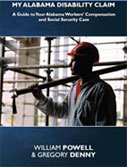
We Wrote the Book
My Alabama Disability Claim by William Powell & Gregory Denny Click Here to Get Your Free Copy


-
 5.0/5.0
A++++++ got results and staff is friendly
-
5.0/5.0
A++++++ got results and staff is friendly
-
5.0/5.0
Persevering for 2-3 years to get my disability. Thank You.
-
5.0/5.0
Persevering for 2-3 years to get my disability. Thank You.
-
 5.0/5.0
William Powell is an excellent attorney and a leader in our local bar.
