
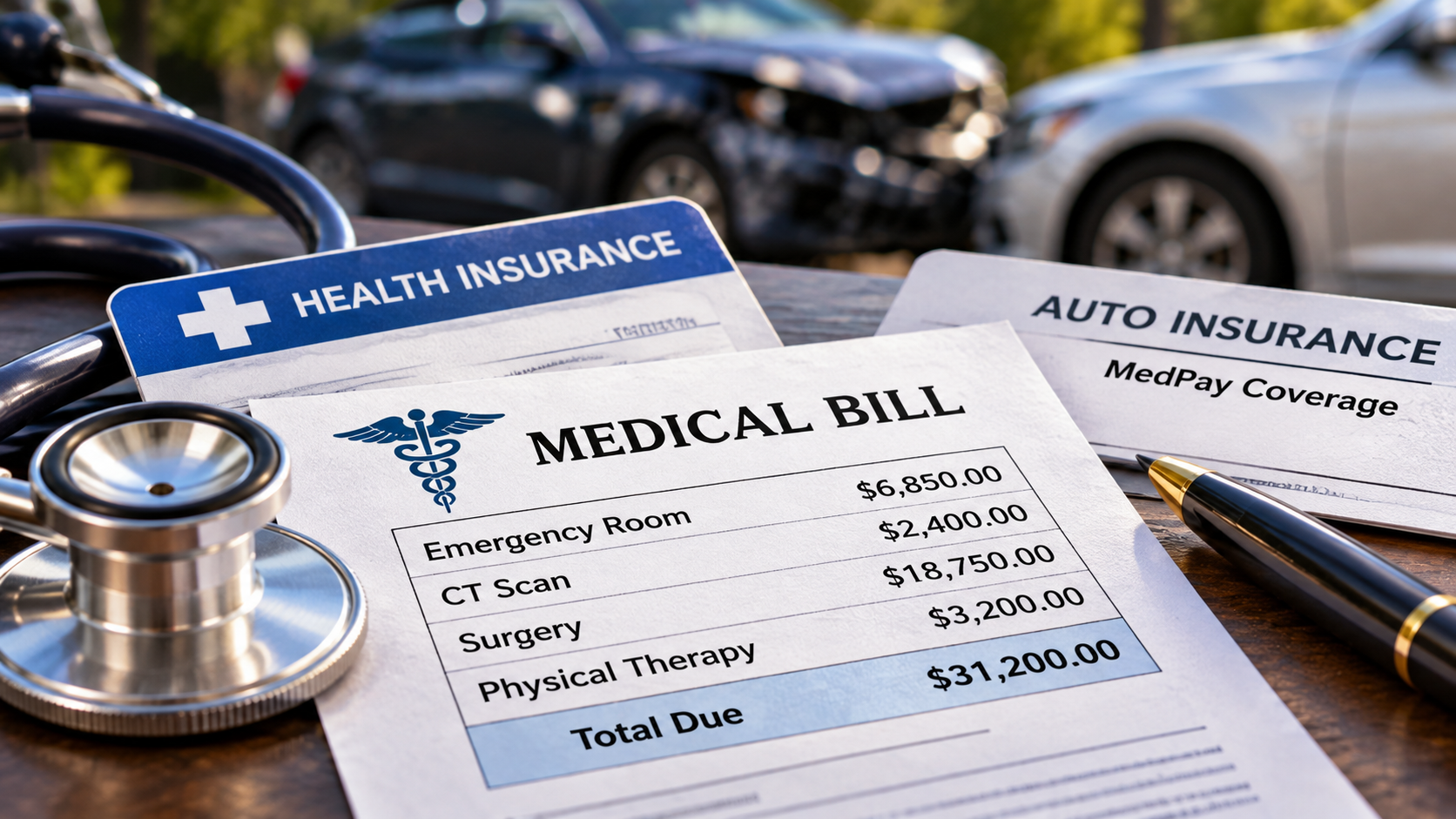
Who Pays My Medical Bills After a Car Wreck in Alabama?
You are injured in a car wreck caused by another driver. An ambulance takes you to the emergency room, where doctors order X-rays, a CT scan, and other tests. You are discharged with instructions to see a specialist, but before that appointment even occurs, the first medical bills begin arriving.
The other driver received a ticket. His insurance company has opened a claim. You assume that because he caused the wreck, his insurance will pay your medical bills. Unfortunately, it usually isn’t that simple.
In Alabama, the insurance company for the driver who caused a car wreck generally does not have to pay your medical bills as you receive treatment. Instead, medical expenses are ordinarily considered part of your personal injury claim, which may be resolved through a settlement or lawsuit.
That distinction leaves many injured people facing an immediate problem: How do you obtain necessary treatment and keep medical bills from becoming unmanageable while your injury claim is still pending?
Why Won’t the Other Driver’s Insurance Company Pay My Medical Bills?
The other driver’s bodily injury liability insurance protects its insured against covered legal liability. It is not the same as health insurance that pays medical providers as treatment occurs.
Even when fault appears obvious, the liability insurer may investigate whether its driver caused the collision, whether the accident caused your injuries, and whether the treatment you received was reasonable and necessary.
Consider someone who suffers a herniated disc after being rear-ended. The insurance company might acknowledge that its driver caused the collision but dispute whether the wreck caused the disc injury or whether surgery was necessary.
We discuss that distinction in “The Insurance Company Says the Car Wreck Didn’t Cause My Injury. How Do I Prove It Did?” An insurer’s acceptance of responsibility for the collision does not necessarily mean it accepts responsibility for every medical expense.
The insurer may eventually offer a settlement that includes medical expenses and other damages, but a settlement ordinarily requires the injured person to release the covered claims. That makes it especially important to understand the extent of the injury and the likelihood of future treatment before resolving the case.
Meanwhile, the hospital and doctors still expect payment.
Can I Use My Own Health Insurance After a Car Wreck?
In many cases, yes. Your health insurance may be the most practical way to obtain treatment while your personal injury claim is pending.
Suppose your emergency-room treatment generates $18,000 in charges. Your health insurance may process those charges according to its provider contracts, deductibles, copayments, and other coverage provisions. You may still owe your deductible or coinsurance, but using available health coverage can prevent you from having to pay the entire hospital bill out of pocket.
Some people hesitate to use health insurance because they believe the other driver should be responsible. That concern is understandable, but refusing to use available coverage can create unnecessary financial pressure.
There is, however, an important consideration: Your health insurance company may have a right to reimbursement if you later recover money from the responsible driver.
Those rights depend upon the type of health plan, the plan’s terms, and applicable state or federal law. Employer-sponsored plans, Medicare, Medicaid, and other health benefit programs such as workers’ compensation may be governed by different reimbursement rules.
For that reason, the amount paid by health insurance should be documented, and potential reimbursement obligations should be investigated before settlement. Using health insurance today does not necessarily mean you can keep the entire amount of a later personal injury settlement without addressing those payments.
What Is MedPay, and Can It Help With My Medical Bills?
Some automobile insurance policies include optional medical payments coverage, commonly called MedPay.
Unlike bodily injury liability coverage, MedPay generally provides payment for covered accident-related medical expenses without requiring proof that another driver was negligent. Depending on the policy, MedPay may help with ambulance charges, emergency treatment, deductibles, copayments, and other covered medical expenses up to the available limit.
For example, suppose your automobile policy includes $5,000 in MedPay coverage. After a collision, that coverage may help pay qualifying medical expenses even while the other driver’s insurer is investigating the claim.
MedPay is particularly useful when a person has a high health insurance deductible or limited funds available for immediate treatment; however, MedPay coverage is not unlimited, and its terms matter. Policy limits, covered persons, qualifying expenses, deadlines, and any reimbursement provisions should be reviewed.
You should not assume that your automobile policy includes MedPay simply because you have liability or uninsured motorist coverage.
What If I Don’t Have Health Insurance?
This can be one of the most difficult situations following a serious collision. An uninsured person may need emergency treatment, diagnostic testing, physical therapy, or surgery without having an insurance company available to pay the providers.
Hospitals and physicians may offer financial assistance, payment arrangements, or other options depending on their policies and the patient’s circumstances. Some medical providers may agree to postpone collection of their bills while a personal injury claim is pending. Such arrangements sometimes involve a letter of protection or another written agreement addressing payment from a future recovery.
These agreements require careful attention.
A letter of protection does not guarantee that the personal injury claim will succeed or that the settlement will be sufficient to cover the treatment. Depending on the agreement, the patient may remain personally responsible for the charges even if the case produces little or no recovery.
The same concern applies to medical liens and other claims against settlement proceeds.
An injured person should understand the financial obligations associated with treatment before entering an agreement that may affect a later settlement.
If Health Insurance Pays My Bills, Can I Still Recover Medical Expenses?
Potentially, but Alabama law requires a more careful answer than simply saying that the negligent driver must pay the full amount of every hospital bill.
Under Ala. Code § 12-21-45, evidence that medical expenses have been or will be paid by another source may be admitted in a personal injury lawsuit. The statute also permits evidence concerning the cost of obtaining those payments and applicable reimbursement obligations.
The Alabama Court of Civil Appeals addressed this issue in Crocker v. Grammer, 87 So. 3d 1190, 1191–94 (Ala. Civ. App. 2011). That case arose from an automobile collision. At trial, the injured plaintiff obtained a $36,500 verdict, but the trial court had excluded evidence that third parties paid his medical expenses. The trial judge reasoned that Alabama’s Rules of Evidence had displaced § 12-21-45.
The Court of Civil Appeals disagreed. It explained that the statute remained applicable and allowed evidence of collateral-source medical payments. The Court further recognized that the jury could consider that evidence in deciding what medical-expense damages were appropriate.
The decision illustrates an important distinction: Medical bills, insurance payments, and the amount ultimately recoverable as damages are related questions, but they are not always identical.
For example, a hospital may bill $30,000, accept a negotiated payment from health insurance, and adjust the remaining charges under its contract. Whether the injured person must reimburse the insurer is another question.
Those details can matter when determining medical damages and evaluating settlement.
They also explain why a personal injury attorney needs more than a stack of original hospital bills. The attorney may need the payment records, contractual adjustments, outstanding balances, and information about reimbursement claims.
What Happens If My Medical Bills Are More Than the Other Driver’s Insurance?
Unfortunately, this is a common problem in serious Alabama car wreck cases. Alabama’s minimum automobile liability insurance requirement is generally $25,000 for bodily injury to one person, $50,000 for bodily injuries arising from one accident, and $25,000 for property damage.
A single hospitalization or surgery can exceed $25,000.
Suppose another driver causes a collision that leaves you with $90,000 in medical expenses, months of lost income, and a permanent physical limitation. If that driver has only $25,000 in bodily injury liability coverage, the available liability insurance may be insufficient to compensate you fully.
That does not necessarily mean the available recovery is limited to $25,000.
Other potentially applicable insurance must be investigated, including uninsured or underinsured motorist coverage. The responsible driver or another legally liable party may also have assets or additional insurance, depending on the circumstances.
Our article “What If the Driver Who Hit Me Doesn’t Have Enough Insurance to Pay for My Injuries?” addresses why identifying all available coverage can be especially important after a catastrophic injury.
A person facing substantial medical bills should not assume that the first insurance policy identified represents the only possible source of compensation.
What If I Was Injured While Working?
A car wreck that occurs during covered employment may involve an entirely different source of medical benefits. For example, a delivery driver injured by another motorist while making deliveries may qualify for Alabama workers’ compensation benefits, including authorized medical treatment.
The worker may also have a separate personal injury claim against the negligent driver.
Those claims can interact through reimbursement and subrogation rights under Ala. Code § 25-5-11.
We explain the distinction in “I Was Hit by Another Driver While Working—Do I Have a Workers’ Compensation Claim and a Car Accident Claim?” Because workers’ compensation has its own rules concerning medical treatment, reporting, and reimbursement, those cases should be evaluated differently from an ordinary non-work-related collision.
What Should I Do When Medical Bills Start Arriving?
One of the most important things an injured person can do is maintain accurate records of the medical expenses associated with the collision. Keep the bills, insurance explanations of benefits, receipts, and correspondence from providers or collection agencies. Make sure the medical providers have accurate health insurance information, and ask about available coverage or financial assistance when necessary.
It is also important to distinguish between the amount originally billed, the amount insurance paid, contractual adjustments, and the amount you personally owe.
Those figures may be very different.
If an insurance company offers to settle your claim while you are still receiving treatment, consider whether additional medical expenses are likely. A settlement that appears adequate today may be insufficient if your physician later recommends surgery or determines that you will need continuing care.
Our article “What Happens When You File a Car Wreck Lawsuit in Alabama?” explains how unresolved disagreements over medical expenses and other damages may eventually lead to litigation.
Don’t Let Medical Bills Determine the Value of Your Entire Claim
Medical expenses are an important part of a personal injury case, but they are not the only consideration. A person who suffers a serious injury may also experience lost wages, permanent physical limitations, diminished earning capacity, chronic pain, and other losses.
Two people can have similar hospital bills but very different long-term consequences.
One may recover completely and return to work. The other may require additional treatment and never regain the physical ability to perform the same job. That is why a serious car wreck claim should be evaluated based on the full consequences of the injury, not simply the total of the medical bills received so far.
Talk With Powell & Denny About Medical Bills After an Alabama Car Wreck
If you have been injured in an Alabama car wreck, you may be dealing with medical bills long before the insurance company is willing to discuss a fair settlement. At Powell & Denny, P.C., we represent injured Alabamians in personal injury cases. We help clients investigate available insurance coverage, document medical expenses, understand potential reimbursement obligations, and pursue compensation for the injuries caused by another person’s negligence.
If you have questions about bringing a claim, don’t hesitate to contact and speak with one of the experienced Alabama Car Wreck attorneys at Powell and Denny today for a free consultation. Appointments are available in person, or virtually via Zoom if more convenient. Powell and Denny would appreciate the opportunity to help. And remember, there is no fee unless you win.
Powell & Denny: We Work When You Can’t.
We Wrote the Book
My Alabama Disability Claim by William Powell & Gregory Denny Click Here to Get Your Free Copy


-
 5.0/5.0
A++++++ got results and staff is friendly
-
5.0/5.0
A++++++ got results and staff is friendly
-
5.0/5.0
Persevering for 2-3 years to get my disability. Thank You.
-
5.0/5.0
Persevering for 2-3 years to get my disability. Thank You.
-
 5.0/5.0
William Powell is an excellent attorney and a leader in our local bar.
