
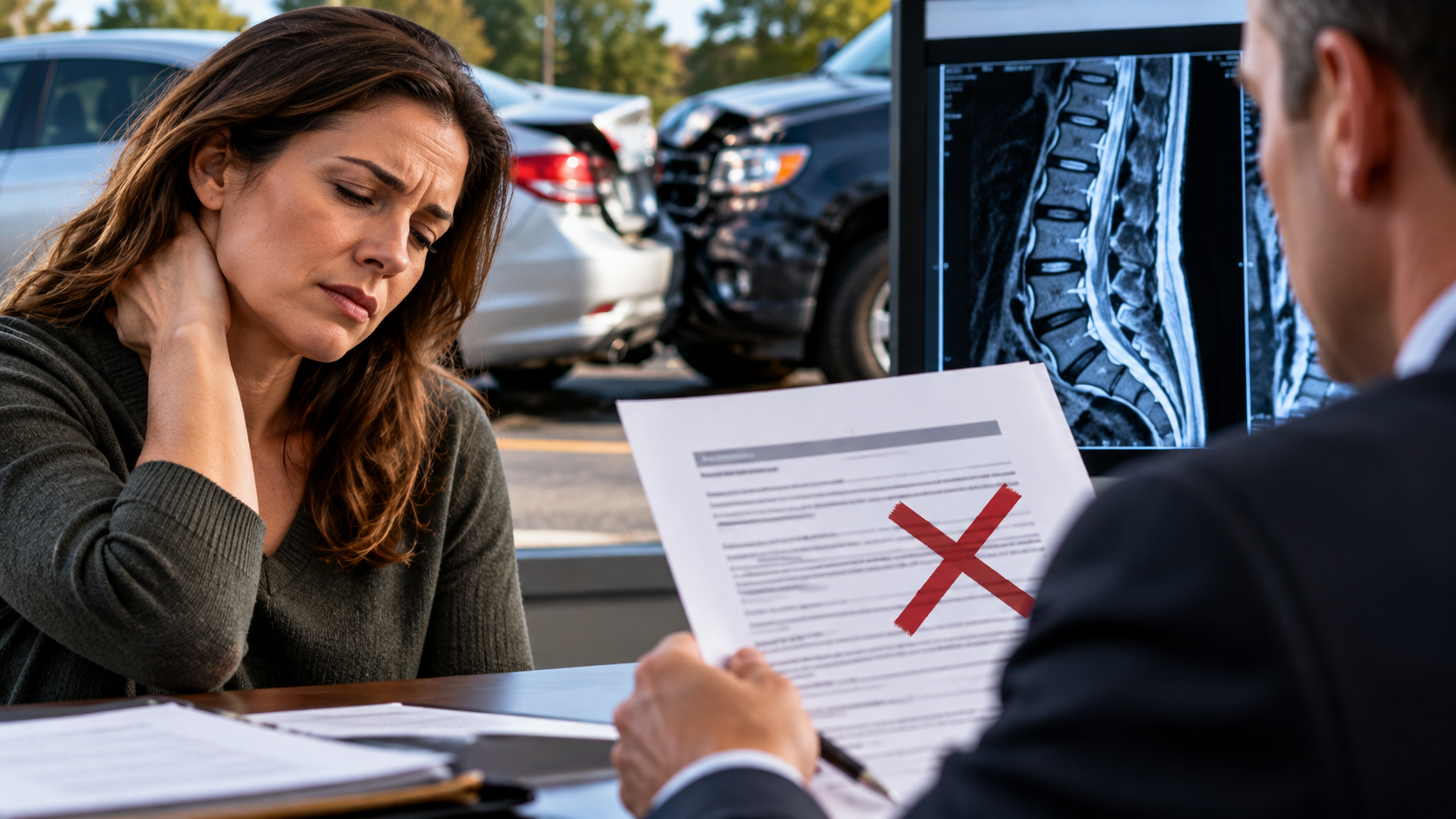
The Insurance Company Says the Car Wreck Didn’t Cause My Injury. How Do I Prove It Did?
You were injured in an Alabama car wreck. The other driver received a traffic citation, and the insurance company may even admit that its driver caused the collision, but when you submit your medical bills, the insurance adjuster tells you something unexpected: “We’re not disputing the accident. We’re disputing whether the accident caused your injuries.”
Perhaps an MRI revealed a herniated disc. The insurance company argues that the condition developed before the wreck. Maybe you have persistent neck or back pain, but the adjuster insists that the collision was not severe enough to cause it.
This is a dispute over medical causation, and it can be one of the most important issues in an Alabama personal-injury case.
The good news is that an insurance company’s disagreement does not decide whether the accident caused your injury. That question must be evaluated using the medical evidence, the circumstances of the collision, and applicable Alabama law.
What Is Medical Causation in an Alabama Car Wreck Case?
Medical causation concerns whether the automobile collision caused or contributed to the particular injury for which you are seeking compensation. There are two distinct questions in many automobile accident cases:
- Liability: Did the other driver negligently cause the collision?
- Medical causation: Did that collision cause the injuries and losses for which you are seeking compensation?
Proving the first does not automatically establish the second. For example, an insurance company might acknowledge that its insured ran a red light and struck your vehicle but argue that the collision did not cause the back condition for which you later underwent surgery.
Under Alabama law, the injured person generally must prove that the defendant’s negligence proximately caused the injuries being claimed. The Alabama Supreme Court addressed this distinction in Pacheco v. Paulson, 472 So. 2d 980 (Ala. 1985).
What Happened in Pacheco v. Paulson?
In Pacheco, a driver was stopped at an intersection in Birmingham when another vehicle struck her car from behind. The collision caused relatively minor property damage, bug the injured driver testified that she developed neck pain later that evening and sought medical treatment. She continued to report pain, received additional treatment, and eventually entered a pain-management program.
The other driver did not dispute that the vehicles collided. The central disagreement was whether the collision had caused the plaintiff’s claimed injuries.
The jury returned a verdict for the defendant.
On appeal, the Alabama Supreme Court affirmed the judgment. The Court explained that the jury could have believed that the plaintiff experienced pain but concluded that the pain was not caused by the automobile collision. In it’s ruling, the Alabama Supreme Court distinguished cases in which the evidence of injury and causation was undisputed:
“…the plaintiffs offered [no] expert evidence to the effect that the accident was the cause of the injuries complained of. Here, there is no direct evidence that the accident caused the injury. This is not to say that there was no evidence from which the jury could have found that the accident was the proximate cause of the alleged injury, but simply to point out that the question of proximate cause of the alleged injury was one for the jury.” Pacheco v. Paulson at 982.
The important lesson is that proving an accident occurred is not necessarily the same as proving that it caused a particular medical condition.
That does not mean a minor collision cannot cause an injury. It means the causal relationship must be established by the evidence.
How Can Medical Records Help Prove That the Wreck Caused My Injury?
Medical records are often among the most important evidence in a disputed-causation case. A physician’s records may document when symptoms began, which body parts were affected, the patient’s description of the collision, examination findings, diagnostic testing, and the treatment recommended.
Consider a person who had no significant neck complaints before a collision. Following the wreck, the person reports neck pain radiating into an arm. An examination reveals weakness or sensory changes, and an MRI identifies a cervical disc herniation. Those findings may support a connection between the collision and the injury; however, an MRI by itself does not necessarily establish when a disc herniation occurred or what caused it.
The medical history, examination findings, diagnostic studies, and physician’s assessment must be considered together.
A treating physician may be able to explain whether the mechanism of injury, onset of symptoms, and medical findings are consistent with the collision.
Does My Doctor Have to Say the Accident Caused My Injury?
Medical testimony can be especially important when causation is disputed or involves a condition that cannot readily be evaluated without specialized knowledge. For example, determining whether a collision caused or aggravated a spinal condition may require a physician to consider prior imaging, degenerative changes, neurological findings, and other possible explanations.
There is an important distinction between a physician saying an accident could have caused an injury and offering an opinion that the accident probably caused or contributed to the injury.
A statement that an accident was merely one possible cause may be insufficient, standing alone, to establish causation, but Alabama law does not require every causation question to be answered using particular words or a rigid formula. The sufficiency of the evidence depends on the nature of the injury and the entire evidentiary record.
A useful practical question is whether the treating physician has considered the patient’s prior condition, the mechanics of the collision, the onset of symptoms, and the objective findings before reaching a causation opinion.
What If the Insurance Company Says My Injury Was Already There?
This is a common argument involving spinal injuries.
An MRI may reveal degenerative disc disease, arthritis, spinal stenosis, or another condition that existed before the collision.
The insurance company may argue that because the condition was preexisting, the wreck could not have caused the current symptoms, but that conclusion does not necessarily follow.
An automobile collision may aggravate a previously asymptomatic condition or make an existing condition substantially worse.
What Did the Alabama Supreme Court Decide in J.B. Hunt Transport v. Credeur?
In J.B. Hunt Transport, Inc. v. Credeur, 681 So. 2d 1355, 1362–63 (Ala. 1996), a truck driver alleged that another tractor-trailer caused him to leave the roadway and overturn his truck.
The plaintiff had a preexisting spinal condition known as spondylitic disease; however, his physicians testified that the accident aggravated a condition that had previously been asymptomatic. Following the accident, the plaintiff experienced continuing pain, reduced cervical range of motion, and difficulty returning to his occupation as a truck driver.
The defendant challenged whether the plaintiff had presented sufficient evidence that the collision caused his future losses. The Alabama Supreme Court rejected that argument, recognizing the medical evidence that the accident had aggravated the previously asymptomatic
This case illustrates an important principle: A person does not have to prove that an automobile accident created every underlying medical abnormality. In an appropriate case, the compensable injury may be the aggravation of a condition that already existed.
The injured person must still prove the aggravation and the resulting losses were caused by the collision.
Recommended reading: What If I Had a Preexisting Injury Before My Alabama Car Wreck?
What If My Doctors Disagree About What Caused My Pain?
Disagreement among physicians can make medical causation particularly difficult. One physician may attribute ongoing pain to the automobile accident. Another may believe that the symptoms result from degeneration, an unrelated medical condition, or another cause.
In Carter v. Reid, 540 So. 2d 57 (Ala. 1989), the Alabama Supreme Court considered a case involving a motor vehicle collision and extensive subsequent medical treatment.
The plaintiff presented evidence of more than $47,000 in medical expenses, but physicians disagreed about the cause of her continuing pain. The jury awarded substantially less than the medical expenses presented. The Supreme Court affirmed, explaining that the jury could accept that treatment occurred and was reasonable while nevertheless finding that some of the treatment was not necessitated by injuries caused by the collision.
This decision demonstrates why medical bills alone may not establish the value of a personal-injury claim; the injured person must connect the treatment and claimed losses to the accident.
When physicians disagree, the underlying medical records, the accuracy of the history provided, and the reasons supporting each opinion become particularly important.
Can I Prove My Injury Was Caused by the Wreck Without an MRI or Other Objective Test?
Potentially, yes.
Not every legitimate injury produces an abnormal MRI, CT scan, or X-ray. Muscle strains, soft-tissue injuries, and certain pain conditions may not be established by a single diagnostic image; however, the absence of objective findings can create an evidentiary dispute, particularly when the claimed symptoms are severe or prolonged.
In Glanton v. Huff, 404 So. 2d 11, 12–13 (Ala. 1981), the Alabama Supreme Court reviewed a rear-end collision in which the vehicles did not sustain extensive property damage, but the medical evidence established that the plaintiff had suffered an injury from the collision. The Court concluded that, under the undisputed evidence presented in that case, the jury could determine the extent of the injury but could not disregard the fact that some injury had occurred.
The distinction is important: The Court did not hold that every rear-end collision necessarily causes an injury. It held that the particular evidence in Glanton established an accident-related injury so conclusively that the jury’s defense verdict was against the great weight of the evidence.
What evidence established the injury?
Mrs. Glanton was stopped at a red light when Huff’s vehicle struck hers from behind. Although the collision caused relatively little visible property damage, the following evidence was presented:
- Prompt medical treatment. Several hours after the collision, Mrs. Glanton went to the hospital complaining of neck and back pain. She was fitted with a neck brace and prescribed medication.
- Substantial subsequent treatment. Six days later, Dr. McLeod examined her and arranged for hospitalization. She received traction, physical therapy, and medication during a ten-day hospital stay. Physical therapy continued afterward.
- Medical testimony identifying an injury. Dr. McLeod testified that she suffered an acute cervical strain, commonly called whiplash, and described a partial permanent injury involving her neck and back.
- No competing medical explanation identified in the opinion. The Court described the medical evidence establishing an accident-related injury as clear, notwithstanding the dispute over the severity of the impact.
The defense emphasized that Huff described the collision as a mild bump and that the investigating officer found no visible vehicle damage. Nevertheless, the majority concluded that this evidence did not justify disregarding the established injury.
Why couldn’t the jury simply reject the doctor’s testimony?
Ordinarily, a jury has considerable discretion to evaluate medical testimony, assess credibility, and determine whether the plaintiff proved causation, but that discretion is not unlimited.
The majority concluded that Huff’s own testimony established a breach of his duty to maintain control of his vehicle, and the medical evidence established that Mrs. Glanton suffered some injury from the collision. Consequently, although the jury remained free to determine the extent of her injuries, it could not disregard the fact that some injury occurred.
The decision does not mean that every rear-end collision causes a compensable injury. Rather, it illustrates that the nature and extent of the evidence—not simply the amount of vehicle damage—determine whether injury and causation have been established.
A subsequent Alabama decision clarifies the holding
In Reed v. Boyd, 642 So. 2d 448, 450 (Ala. 1994), the Alabama Supreme Court distinguished Glanton from another automobile-collision case involving disputed medical causation.
The Court explained that Glanton involved an undisputed significant injury requiring hospitalization and traction, with no evidence identifying another possible cause. By contrast, in Reed, evidence suggested that the plaintiff’s complaints could have resulted from degenerative aging or an earlier accident. The Court therefore upheld the defense verdict.
That distinction is significant. When the evidence permits reasonable disagreement about whether the collision caused the injury, the jury may resolve that disagreement against the plaintiff
Does the Amount of Damage to My Car Determine Whether I Was Injured?
No. The amount of visible property damage is not, by itself, a legal determination of whether a person sustained an injury; however, the severity and mechanics of the collision may be relevant evidence.
An insurance company may argue that a relatively minor impact was unlikely to cause a serious spinal injury. The injured person may respond with medical testimony, evidence concerning the collision, and documentation of symptoms and physical changes afterward.
As Pacheco demonstrates, the jury may evaluate competing evidence about whether a particular collision caused the claimed injuries.
The question is not simply whether the bumper was badly damaged. The question is whether the evidence establishes that the collision caused or contributed to the injury being claimed.
What Evidence Is Most Important When the Insurance Company Disputes Medical Causation?
A disputed-causation case often turns on several categories of evidence:
- Medical records before the wreck: These may establish whether the employee or driver had prior symptoms, treatment, or physical restrictions.
- Medical records after the wreck: These document complaints, examinations, diagnoses, and treatment.
- Physician opinions: A treating or evaluating physician may explain the relationship between the collision and the diagnosed condition.
- Diagnostic studies: MRIs, X-rays, and other testing may identify abnormalities and, when compared with earlier studies, help establish changes.
- Witness testimony: Family members, coworkers, or others may describe changes in the injured person’s physical abilities.
- Employment records: Missed work, modified duties, and documented restrictions may help establish the consequences of the injury.
- Collision evidence: Photographs, vehicle damage, accident reports, and other evidence may help explain the forces and circumstances involved.
No single item necessarily resolves the dispute. The strength of the claim often depends upon how consistently the evidence supports the alleged relationship between the collision and the injury.
What If I Didn’t Go to the Emergency Room or My Symptoms Started Later?
Delayed symptoms and delayed medical treatment may complicate a causation dispute, but neither automatically establishes that the accident did not cause an injury.
The insurance company may question why the first medical complaint occurred several days after the collision.
The injured person may have an explanation involving the initial symptoms, the progression of pain, or other circumstances.
The medical evidence must still establish the necessary causal relationship.
We address those questions separately in our articles “I Didn’t Go to the Emergency Room After My Alabama Car Wreck. Can I Still Recover?” and “Can a Gap in Medical Treatment Hurt My Alabama Car Wreck Case?”
What If I Had Another Accident After the Car Wreck?
A later accident, fall, or other injury may create an additional causation question. For example, someone may sustain a back injury in an automobile collision and later fall at home.
The insurer may contend that the later fall—not the automobile collision—caused the condition requiring surgery. The analysis may require medical evidence distinguishing the effects of the original injury from the later event.
A subsequent accident does not automatically eliminate responsibility for injuries caused by the earlier collision. But the plaintiff cannot simply attribute every later medical problem to the original wreck without supporting evidence.
What If I Cannot Return to Work Because of My Injury?
When an automobile collision causes permanent physical restrictions, medical causation may affect more than the reimbursement of medical expenses. It can also affect claims for lost wages and diminished earning capacity.
A construction worker with a lumbar injury may be unable to perform heavy lifting. A truck driver with a cervical injury may be unable to tolerate prolonged driving. A healthcare employee with a shoulder injury may be unable to transfer patients.
In these situations, the medical evidence must connect the accident to the physical restrictions.
The vocational evidence may then help establish how those restrictions affect the person’s ability to work and earn a living.
An insurer may concede that the collision caused a temporary injury while disputing whether it caused the permanent restrictions. That distinction can substantially affect the value of the claim.
Recommended readings: “What If a Car Wreck Permanently Reduces My Ability To Work?
Can I Get Social Security Disability After a Serious Car Wreck?
Talk With an Alabama Car Wreck Lawyer
If an insurance company claims that your injuries were not caused by an Alabama automobile accident, the dispute may require careful review of your medical history, diagnostic studies, treating physicians’ opinions, and evidence concerning the collision.
At Powell & Denny, P.C., we help injured Alabamians evaluate personal-injury claims involving disputed medical causation, preexisting conditions, permanent restrictions, and loss of earning capacity. We also understand how serious injuries can affect an individual’s ability to return to work and may raise related workers’ compensation or Social Security Disability questions, so if you or a loved one has been injured in an Alabama car wreck and you have questions about what to do— don’t hesitate to contact and speak with one of the experienced Alabama Car Wreck attorneys at Powell and Denny today for a free consultation. Appointments are available in person, or virtually via Zoom if more convenient. Powell and Denny would appreciate the opportunity to help. And remember, there is no fee unless you win.
Powell & Denny: We Work When You Can’t.
Recommended Reading
We Wrote the Book
My Alabama Disability Claim by William Powell & Gregory Denny Click Here to Get Your Free Copy


-
 5.0/5.0
A++++++ got results and staff is friendly
-
5.0/5.0
A++++++ got results and staff is friendly
-
5.0/5.0
Persevering for 2-3 years to get my disability. Thank You.
-
5.0/5.0
Persevering for 2-3 years to get my disability. Thank You.
-
 5.0/5.0
William Powell is an excellent attorney and a leader in our local bar.
