

Occupational Diseases and Alabama Workers Compensation Claims
Most people think of a workplace injury as a sudden event—a fall, a lifting accident, or another incident that causes immediate pain. But not all work-related injuries happen in a single moment. Some develop slowly over time due to repeated exposure to harmful conditions or repetitive job duties. These conditions are known under Alabama law as occupational diseases.
Recent national reporting has highlighted serious lung damage among workers who manufacture engineered stone countertops, where exposure to silica dust can cause long-term respiratory illness. Similar job-related diseases have long been associated with coal dust, asbestos, excessive workplace noise, repetitive motion, radiation exposure, and other hazardous conditions. Alabama’s Workers’ Compensation Act recognizes these types of illnesses—including repetitive stress conditions such as carpal tunnel syndrome—as potentially compensable occupational diseases.
What Is an Occupational Disease?
Under Alabama law, an occupational disease is generally a disease arising out of and in the course of employment that results from hazards:,
- Greater than those found in ordinary employment, and
- Peculiar to the worker’s specific occupation,
- Occurring over a period of time, rather than from a single accident.
This definition can seem technical, but the key idea is simple:
the illness must be caused or worsened by unique dangers or repetitive demands of the job, not merely by everyday life.
Conditions that may qualify include:
- Black lung and other pneumoconiosis
- Asbestos-related disease and mesothelioma
- Occupational asthma or COPD
- Hearing loss from prolonged noise exposure
- Certain cancers or radiation-related illness
- Carpal tunnel syndrome and other repetitive-motion injuries
- Chronic respiratory or pulmonary disease
No specific diagnosis is automatically excluded—but the illness must meet the legal requirements described below.
The Disease Must Be Serious and Chronic
Alabama courts have made clear that an occupational disease must be more than temporary discomfort.
A short-term flare-up of symptoms that later resolves will usually not qualify.
Instead, the condition must involve a serious, lasting impairment that chronically affects the worker’s health or ability to function.
This is particularly important in repetitive-stress cases like carpal tunnel syndrome, where symptoms may begin gradually but can eventually cause permanent nerve damage, weakness, or loss of hand function if left untreated.
Proving an Occupational Disease Claim
To recover workers’ compensation benefits for an occupational disease in Alabama, a worker must generally show:
- Exposure to a specific workplace hazard or repetitive activity
- Repeated or prolonged exposure over time
- Exposure greater than what the general workforce experiences
- Medical evidence that the exposure caused or contributed to the disease
(or worsened a preexisting condition)
Some illnesses—like black lung in coal miners, mesothelioma from asbestos exposure, or carpal tunnel syndrome caused by repetitive hand-intensive work—naturally align with particular occupations and may be easier to connect to the job.
Other conditions, such as COPD, heart disease, or certain cancers, can be more difficult because they may have multiple possible causes. In those cases, detailed medical and occupational evidence becomes especially important.
Notice and Time Limits Are Different From Accident Cases
Traditional workplace injuries usually have a specific date, and Alabama law typically requires notice within 90 days of the accident.
Occupational diseases are different.
Because they develop gradually over months or years, there may be no clear injury date.
For that reason, Alabama law generally requires that a workers’ compensation claim for an occupational disease be filed or settled within two years of the worker’s last exposure to the harmful condition or repetitive activity that caused the illness.
Understanding this distinction is critical, because waiting too long after leaving the hazardous environment—or after repetitive-stress symptoms begin—can prevent recovery of benefits.
Why Occupational Disease Claims Matter
Occupational diseases can be life-altering. Many involve chronic lung damage, cancer, permanent hearing loss, or lasting nerve and mobility problems such as those caused by advanced carpal tunnel syndrome. These conditions may affect both long-term health and the ability to continue working.
Alabama’s workers’ compensation system exists not only for sudden accidents, but also to protect workers whose jobs gradually make them ill or injure them through repetition. When the legal requirements are met, benefits may include:
- Medical treatment
- Wage-replacement benefits
- Compensation for permanent disability
The Bottom Line
Not every work-related illness qualifies as an occupational disease—but many serious, chronic conditions do when they are caused or worsened by hazards or repetitive demands unique to the job.
Because these claims develop slowly and involve complex medical proof and strict time limits, understanding how Alabama law treats occupational disease—including repetitive-stress injuries like carpal tunnel syndrome—is essential to protecting your rights.
Workers’ compensation is meant to cover both sudden injuries and diseases caused by the work itself, even when they take years to appear.
If you have suffered a work injury or believe that you have suffered a job illness/occupational disease such as COPD, pneumoconiosis, cancer, hearing loss, emphysema, black lung, mesothelioma, carpal tunnel syndrome, cubital tunnel syndrome or some other illness and you have questions about your rights under the Alabama Workers’ Compensation law -don’t hesitate to contact and speak with one of the experienced Alabama Workers Compensation and Social Security Disability attorneys at Powell and Denny today for a free consultation. Appointments are available in person, or virtually via Zoom if more convenient. Powell and Denny would appreciate the opportunity to help. And remember, there is no fee unless you win.
Powell and Denny: We Work When You Can’t
Offices in Huntsville, AL and Birmingham, AL
Alabama Workers’ Compensation Attorneys
Birmingham Workers’ Compensation Lawyers
Central Alabama Workers’ Compensation Attorneys
Huntsville Workers’ Compensation Attorneys
North Alabama Workers Compensation Lawyers
Tennessee Valley Workers Compensation Lawyers
Powell and Denny have been selected as one of the Best Law Firms by U.S. News and World Report for each of the last 7 years, have been selected as one of Birmingham’s Top Lawyers by B-Metro Magazine for the last 3 years, have been selected by The National Advocates as one of the Top 20 Workers’ Compensation Firms (plaintiffs) and Powell and Denny, P.C.-has been selected as one of the “Best of the Best” law firms by The American Registry
Mr. Denny is AV rated by Martindale Hubbard (the highest rating possible) and Mr. Powell has been rated as Superior by The National Registry and selected as a Lawyer of Distinction.
+ Powell and Denny have successfully represented injured workers from Birmingham, Huntsville, Florence, Muscle Shoals, Tuscumbia, Athens, Decatur, Town Creek Ardmore, Hartselle, Madison, Toney, Scottsboro, Ft. Payne, New Hope, Guntersville, Albertville, Boaz, Ashville, Anniston, Gadsden, Cullman, Jasper, Gardendale, Morris, Kimberly, Centerpoint, Leeds, Tarrant City, Fairfield, Hueytown, Bessemer, Adger, Tuscaloosa, Cordova, Alabaster, Pelham, Harpersville, Opelika, Phenix City, Montgomery, Clanton, Calera, Enterprise, Monroeville, Mobile, Evergreen, Centreville, Brent, West Blocton, Woodstock, Brierfield, Lakeview and towns and cities in between.
Occupational Diseases and Alabama Workers’ Compensation Claims
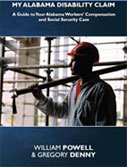
We Wrote the Book
My Alabama Disability Claim by William Powell & Gregory Denny Click Here to Get Your Free Copy


-
 5.0/5.0
A++++++ got results and staff is friendly
-
5.0/5.0
A++++++ got results and staff is friendly
-
5.0/5.0
Persevering for 2-3 years to get my disability. Thank You.
-
5.0/5.0
Persevering for 2-3 years to get my disability. Thank You.
-
 5.0/5.0
William Powell is an excellent attorney and a leader in our local bar.
