

How Can Social Security Find Me Disabled but Workers Compensation Deny Permanent Total Disability?
One of the most frustrating situations an injured worker can face is being awarded Social Security Disability benefits, only to have their employer or workers’ compensation insurance company argue that they are not permanently and totally disabled under Alabama’s Workers’ Compensation Act. Many people understandably ask:
“If the United States Government has already determined that I’m disabled, how can workers’ compensation say I’m not?”
The answer lies in the fact that Social Security Disability and Alabama Workers’ Compensation are different legal systems with different rules for determining disability.
Although they often involve the same injured worker, they are not asking exactly the same question.
Social Security Looks at All of Your Medical Conditions
When Social Security evaluates a disability claim, it considers all of your medically determinable impairments.
That means Social Security may consider:
- your work-related injury;
- arthritis;
- diabetes;
- heart disease;
- obesity;
- depression;
- anxiety;
- COPD;
- kidney disease;
- prior injuries;
- and any other medically determinable condition that affects your ability to work.
Social Security looks at the combined effect of all of your medical problems. Sometimes, no single condition is disabling by itself. Instead, it is the combination of several conditions that prevents a person from performing substantial gainful activity on a regular and continuing basis.
Alabama Workers’ Compensation Is Different
An Alabama workers’ compensation claim is much narrower.
The issue is generally not whether you are disabled because of all of your medical problems; instead, the question is whether your work-related injury—and any conditions that naturally flow from that injury—have left you permanently and totally disabled.
That distinction is extremely important.
Suppose a worker suffers a serious back injury at work. At the same time, the worker also has:
- severe diabetes;
- heart disease;
- arthritis in both knees;
- chronic kidney disease; and
- emphysema.
Social Security may consider every one of those conditions when determining whether the worker is disabled. The workers’ compensation court generally cannot-instead, the court focuses on the disability caused by the work-related injury and its compensable consequences.
A Real-World Example
Imagine a 60-year-old warehouse employee who injures his back lifting heavy equipment.
After surgery, he is left with permanent lifting restrictions.
He also suffers from:
- insulin-dependent diabetes;
- congestive heart failure;
- obesity; and
- severe arthritis unrelated to his work injury.
When Social Security evaluates his claim, it considers all of those conditions together. The combined effect of his back injury, diabetes, heart disease, and arthritis may prevent him from performing substantial gainful activity. As a result, Social Security awards disability benefits.
Now consider the workers’ compensation case. The court must determine whether the work-related back injury, standing alone or together with its compensable consequences, permanently and totally disabled the worker. If the court concludes that many of the worker’s limitations are attributable to unrelated medical conditions rather than the workplace injury, it may deny permanent total disability benefits—even though Social Security has already found the worker disabled.
The two decisions are not necessarily inconsistent because each system is answering a different legal question.
Does That Mean My Social Security Decision Doesn’t Matter?
Not at all.
A favorable Social Security decision may still contain valuable evidence. Medical records, functional limitations, vocational evidence, and testimony developed during the Social Security claim may all be helpful in a workers’ compensation case.
However, the Social Security decision itself does not automatically determine the outcome of your Alabama workers’ compensation claim. Likewise, a workers’ compensation judge is not required to adopt Social Security’s conclusions.
Why This Difference Matters
Understanding the differences between these two systems is important because many seriously injured workers pursue both claims at the same time.
Evidence developed in one case may help the other. Medical records obtained for workers’ compensation may support a Social Security claim.
Likewise, treating physician opinions, functional limitations, and vocational evidence from a Social Security case may become important in workers’ compensation litigation.
Knowing how those two systems interact can make a significant difference in how both claims are presented.
Receiving Social Security Disability benefits does not automatically mean you are entitled to permanent total disability benefits under Alabama’s Workers’ Compensation Act. Likewise, being denied permanent total disability benefits does not necessarily prevent you from qualifying for Social Security Disability. The reason is simple.
Social Security generally evaluates all of your medically determinable impairments when deciding whether you can perform substantial gainful activity. Alabama workers’ compensation generally focuses on the disability resulting from the work-related injury and its compensable consequences.
Although the evidence in the two cases may overlap, the legal standards are different.
Understanding those differences is one of the reasons it can be beneficial to work with an attorney who regularly handles both Alabama Workers’ Compensation and Social Security Disability claims.
If your application has been denied, or if you have questions about applying for Social Security Disability benefits, or in a claim seeking Alabama Workers’ Compensation benefits, the attorneys at Powell & Denny have represented disabled individuals throughout Alabama for more than 30 years, including successful representation before State Courts, The Alabama Court of Civil Appeals, The Alabama Supreme Court, Administrative Law Judges, the Appeals Council, and the federal courts so don’t hesitate to contact the experienced attorneys at Powell and Denny today a free consultation; remember. Virtual appointments are available through Zoom so you can meet with one of the attorneys of Powell and Denny from wherever you live, and remember-there is no fee unless you win.
Powell & Denny: We Work When You Can’t.
Offices in Huntsville, Alabama and Birmingham, AL
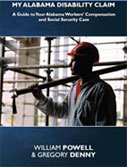
We Wrote the Book
My Alabama Disability Claim by William Powell & Gregory Denny Click Here to Get Your Free Copy


-
 5.0/5.0
A++++++ got results and staff is friendly
-
5.0/5.0
A++++++ got results and staff is friendly
-
5.0/5.0
Persevering for 2-3 years to get my disability. Thank You.
-
5.0/5.0
Persevering for 2-3 years to get my disability. Thank You.
-
 5.0/5.0
William Powell is an excellent attorney and a leader in our local bar.
