

Common Reasons Alabama Workers Compensation Claims Are Denied
And What You Can Do to Protect Your Rights
One of the first questions many injured workers ask after receiving a denial letter is: “How can they deny my claim? I was hurt at work.”
It is a fair question, but simply being injured at work does not automatically guarantee that workers compensation benefits will be paid.
Every year, legitimate Alabama workers’ compensation claims are delayed or denied for a variety of reasons. Some denials are legally justified. Others result from misunderstandings, incomplete investigations, disputed medical evidence, or mistakes made in the days and weeks following an injury. The good news is that a denial is not necessarily the end of your claim.
Many injured workers ultimately recover benefits after additional medical evidence is obtained, depositions are taken, or a judge hears all of the evidence. Understanding why claims are denied is often the first step toward protecting your rights.
First, Remember Who Has the Burden of Proof
Many injured workers believe the employer or insurance company must prove they are not entitled to benefits, but that is not how Alabama law works.
In most workers’ compensation cases, the injured employee has the burden of proving each element of the claim.
Among other things, the employee must generally prove:
- an employer-employee relationship existed;
- the injury occurred during the course of employment;
- the injury arose out of the employment;
- the injury caused the medical condition being claimed; and
- the disability or need for treatment resulted from the work injury.
If the evidence is incomplete or conflicting, disputes frequently arise.
That does not necessarily mean the claim lacks merit. It often means additional evidence is needed.
Recommended Reading: What Must an Injured Worker Prove in an Alabama Workers’ Compensation Case?
- The Injury Was Not Reported Promptly
One of the most common reasons claims become difficult is that the injury was never properly reported.
Many employees think: “It’s probably just a pulled muscle.” They continue working. Days or weeks later, the pain becomes unbearable. Unfortunately, delays often create problems.
The employer may question:
- whether the injury actually occurred at work;
- whether something happened after work;
- whether witnesses can remember the incident.
Alabama law generally requires notice of a work-related injury within the time provided by § 25-5-78, Ala. Code 1975, although actual notice to the employer may satisfy the statute in appropriate circumstances.
The sooner an injury is reported, the fewer factual disputes usually arise.
Learn More: My Employer Said I Waited Too Long to Report My Job Injury-What Can I Do?
- The Employer Says the Injury Did Not Occur at Work
Sometimes everyone agrees the employee is injured, the disagreement concerns where the injury occurred.
The insurance company may argue the injury resulted from:
- a pre-existing condition;
- activities at home;
- recreational activities;
- another job; or
- normal aging.
The issue often becomes one of medical and factual proof. Medical records, witness testimony, accident reports, surveillance, employment records, and physician opinions may all become important evidence.
Learn More: Does it Matter Where My Job Injury Occurred?
What if I was Injured during Lunch Break?
- The Insurance Company Says Your Medical Condition Was Pre-Existing
Perhaps no issue creates more confusion than pre-existing conditions.
Many injured workers are led to believe that just because they have had medical issues with a body part in the past, any subsequent injury to the same body part would not be covered in an Alabama workers compensation claim-that is often incorrect. Many people have arthritis, degenerative disc disease, old injuries, or prior surgeries and continue working for years. The important legal question is often whether the work injury aggravated, accelerated, or combined with the pre-existing condition to produce disability or the need for medical treatment.
Having a pre-existing condition does not automatically defeat an Alabama workers’ compensation claim.
Recommended Reading: Can I Receive Alabama Workers’ Compensation Benefits If I Had a Pre-Existing Condition?
- The Authorized Treating Physician Does Not Relate the Condition to the Work Injury
Medical causation is frequently the most important issue in a workers’ compensation case.
Even if everyone agrees an accident occurred, benefits may be denied if the medical evidence does not connect the injury to the workplace accident.
Insurance companies often rely heavily upon the opinions of the Authorized Treating Physician (ATP).
If the physician concludes:
- the injury is unrelated to work;
- the condition is degenerative only;
- additional treatment is unnecessary; or
- the employee has fully recovered,
the claim often becomes much more difficult.
That does not necessarily end the case. Depositions, additional medical records, diagnostic testing, and testimony from other physicians sometimes change the outcome.
Learn More: Who Is the Authorized Treating Physician and Why Does That Matter?
- There Is a Dispute Over Medical Causation
Not every injury occurs because of one dramatic accident. Some develop gradually.
Examples include:
- repetitive lifting;
- repetitive use of the hands;
- cumulative trauma;
- occupational diseases; and
- repetitive stress injuries.
These cases often require detailed medical testimony explaining how the employee’s work caused or contributed to the condition.
Without persuasive medical evidence, insurers frequently deny the claim.
Recommended Reading: What is an Occupational Disease
- The Insurance Company Believes You Can Return to Work
Many disputes arise after surgery or rehabilitation. The treating physician releases the employee to:
- full duty;
- light duty; or
- sedentary work.
The insurance company may then argue temporary total disability (TTD) benefits should stop.
Whether benefits properly terminate depends upon numerous facts, including:
- the physician’s restrictions;
- whether suitable work is actually available;
- whether the employee remains medically unable to earn wages; and
- the procedural posture of the claim.
These disputes are often far more complicated than they initially appear.
Recommended Reading: How do I pay my bills While I am Off Work? Understanding Alabama’s Workers’ Compensation Benefits
- Inconsistent Medical Records
Insurance adjusters carefully compare:
- emergency room records;
- family physician records;
- specialist records;
- physical therapy notes;
- MRI reports;
- deposition testimony; and
- recorded statements.
Even relatively small inconsistencies may be used to question credibility.
For example:
One record says the employee injured the back lifting at work.
Another says the pain “began yesterday.”
A third says the employee “does not recall any injury.”
Sometimes these inconsistencies result from hurried medical visits rather than dishonesty; nevertheless, they frequently become important evidence.
- Social Media and Surveillance
Many injured workers are surprised to learn that insurance companies sometimes conduct surveillance.
They also review publicly available social media.
A single photograph rarely tells the entire story. Someone may smile in a family photograph despite severe pain. Likewise, a thirty-second video may not reflect what happened before or afterward. Still, social media posts and surveillance videos are frequently introduced as evidence.
That is one reason injured workers should exercise caution when posting online during an active workers’ compensation claim.
- The Injury Falls Into a Legally Disputed Area
Some claims involve complicated legal questions rather than factual disputes.
Examples include:
- idiopathic falls;
- unexplained falls;
- horseplay;
- assaults at work;
- injuries while traveling;
- injuries during breaks;
- recreational activities;
- intoxication defenses; and
- willful misconduct allegations.
These cases often depend upon specific Alabama statutes and appellate decisions.
The facts matter enormously in these situations.
- The Insurance Company Simply Gets It Wrong
Insurance companies investigate thousands of claims every year. Most adjusters attempt to make fair decisions; sometimes, however, legitimate claims are denied because:
- witnesses were never interviewed;
- medical records were incomplete;
- physicians lacked critical information;
- important diagnostic studies were unavailable;
- legal standards were misapplied; or
- the evidence changed after the initial decision.
A denial letter is not a final judgment.
Ultimately, disputed Alabama workers’ compensation cases are decided by the courts—not by the insurance adjuster.
What Should You Do If Your Claim Is Denied?
Do not assume the denial is correct.
Instead:
- continue obtaining appropriate medical treatment;
- preserve medical records;
- identify witnesses;
- document your symptoms;
- follow your physician’s recommendations;
- avoid exaggerating your limitations; and
- promptly seek legal advice if benefits have been denied or terminated.
The earlier problems are identified, the easier they often are to address.
Recommended Reading: My Claim was Denied, What do I do?
The Bottom Line
Most Alabama workers’ compensation claims are not denied because the employee is dishonest or because the injury is insignificant. More often, the dispute involves one of several recurring issues: notice, medical causation, pre-existing conditions, physician opinions, return-to-work questions, or conflicting evidence.
The important point is this:
A denial is not the same as losing your case.
Many denied claims are ultimately resolved in the employee’s favor after additional medical evidence is developed, witnesses testify, physicians are deposed, or a court has the opportunity to hear all of the facts.
If your benefits have been denied, delayed, or terminated, understanding the reason for the denial is the first step toward determining what should happen next.
At Powell and Denny, we have spent decades helping injured workers prove the connection between their workplace accidents and the benefits to which they are entitled under Alabama law.
If you have suffered a job injury and you have questions about your rights and benefits under Alabama’s workers compensation laws -don’t hesitate to contact and speak with one of the experienced Alabama Workers Compensation and Social Security Disability attorneys at Powell and Denny today for a free consultation. Appointments are available in person, or virtually via Zoom if more convenient. Powell and Denny would appreciate the opportunity to help. And remember, there is no fee unless you win.
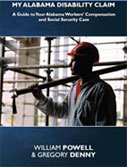
We Wrote the Book
My Alabama Disability Claim by William Powell & Gregory Denny Click Here to Get Your Free Copy


-
 5.0/5.0
A++++++ got results and staff is friendly
-
5.0/5.0
A++++++ got results and staff is friendly
-
5.0/5.0
Persevering for 2-3 years to get my disability. Thank You.
-
5.0/5.0
Persevering for 2-3 years to get my disability. Thank You.
-
 5.0/5.0
William Powell is an excellent attorney and a leader in our local bar.
