
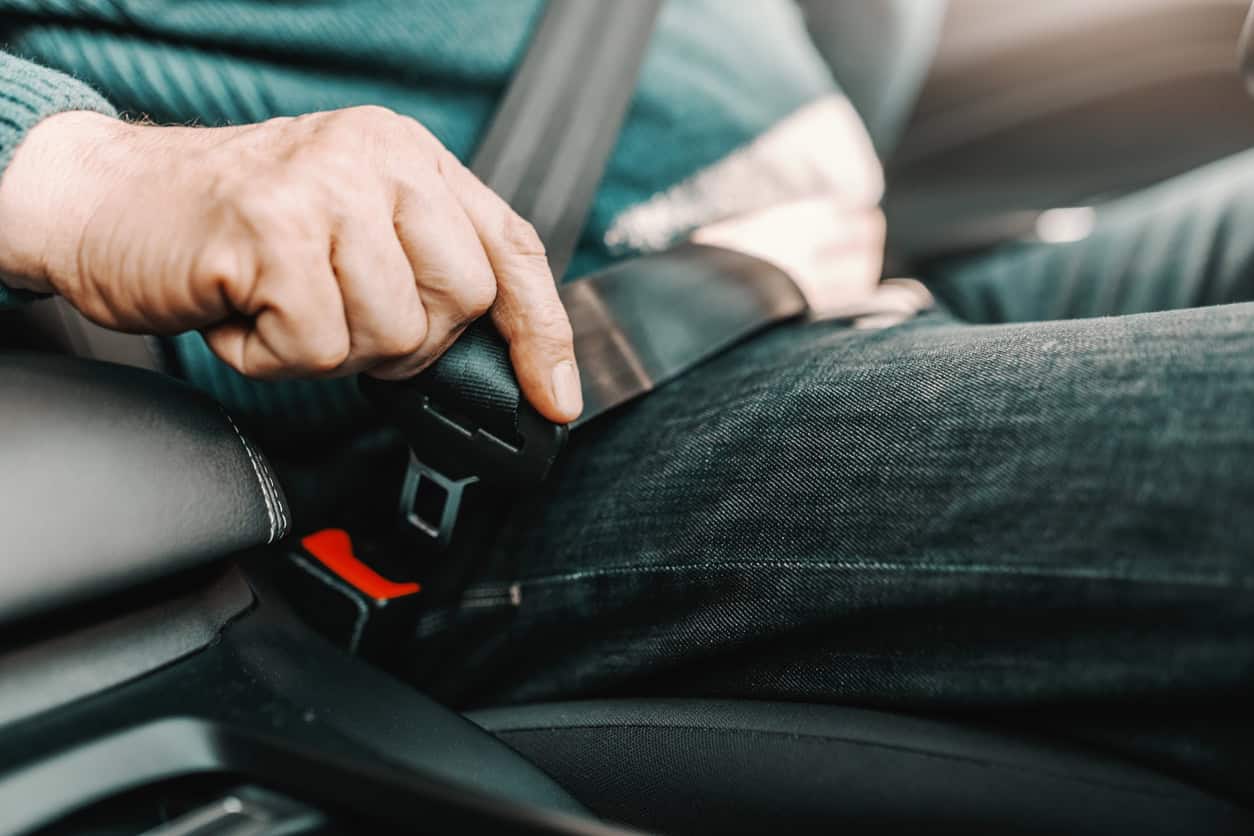
Can the Insurance Company Deny My Alabama Car Wreck Claim Because I Wasn’t Wearing a Seat Belt?
You were injured in a car wreck caused by another driver.
Maybe the other driver ran a red light, pulled into your lane, or rear-ended your vehicle.
But you were not wearing your seat belt.
Now the insurance company is asking about it.
That can lead to an obvious concern:
“Can the insurance company deny my claim because I wasn’t wearing a seat belt?”
Under Alabama law, the answer is generally no.
Alabama has a statute that directly addresses this issue. Under Ala. Code § 32-5B-7, failure to wear a safety belt cannot be considered evidence of contributory negligence and cannot be used to limit the liability of an insurer.
That is particularly important in Alabama because contributory negligence can otherwise operate as a complete defense to an ordinary negligence claim.
The Alabama Legislature has specifically said that failing to wear a seat belt does not establish that defense.
What Does Alabama’s Seat-Belt Law Actually Say?
Alabama’s Safety Belt Act generally requires front-seat occupants of passenger cars manufactured with safety belts to have a safety belt properly fastened while the vehicle is in motion, subject to statutory exceptions.
But the Legislature also addressed what happens when someone violates that requirement.
Ala. Code § 32-5B-7 provides that failure to wear a safety belt in violation of the Act:
- shall not be considered evidence of contributory negligence;
- shall not limit the liability of an insurer; and
- shall not result in the conviction being entered on the individual’s driving record.
The first two provisions are particularly important in a personal injury claim.
They mean that violating Alabama’s seat-belt requirement does not automatically give the insurance company a defense to the injured person’s claim.
Why Does This Matter So Much in Alabama?
It matters because Alabama follows the doctrine of contributory negligence.
As we have discussed elsewhere in this series, contributory negligence can completely bar recovery on an ordinary negligence claim when the defendant proves the requirements of the defense.
An insurance company may therefore investigate whether an injured person:
- was speeding;
- failed to yield;
- was distracted;
- failed to keep a proper lookout; or
- otherwise failed to exercise reasonable care and thereby contributed to causing the collision.
But Alabama’s Legislature has specifically removed failure to wear a seat belt from that contributory-negligence analysis.
An insurance company cannot simply argue:
“You weren’t wearing your seat belt, so you were contributorily negligent.”
Section 32-5B-7 says otherwise.
Recommended Reading: The Insurance Company Says the Car Wreck Was Partly My Fault. Can I Still Recover in Alabama?
But Didn’t I Break the Law by Not Wearing My Seat Belt?
Potentially, yes.
That is what makes this issue confusing.
Something can violate a traffic-safety law without necessarily becoming evidence of contributory negligence in a civil personal injury case.
Alabama law generally requires qualifying occupants to wear seat belts. But the Legislature separately determined the civil consequences of violating that requirement.
The statute does not say:
“If you fail to wear a seat belt, your personal injury claim is reduced.”
It says that the failure shall not be considered evidence of contributory negligence and shall not limit the liability of an insurer.
So there are two different questions:
Were you required to wear a seat belt?
and
Can your failure to wear it be used to defeat your personal injury claim?
Those are not the same legal question.
What Is the “Seat-Belt Defense”?
The term “seat-belt defense” generally refers to an argument that an injured person should not recover all or part of his or her damages because the person was not wearing an available seat belt.
The argument can take different forms.
A defendant might contend that the plaintiff was contributorily negligent.
Or the defendant might acknowledge that failure to wear a seat belt did not cause the collision but argue that wearing one would have prevented or reduced the injuries.
That second argument is sometimes characterized as a failure to mitigate damages or an avoidable-consequences argument.
Alabama has addressed both concepts.
Can the Insurance Company Say My Failure to Wear a Seat Belt Made My Injuries Worse?
Alabama’s treatment of this question goes back more than fifty years.
In Britton v. Doehring, 242 So. 2d 666 (Ala. 1970), the Alabama Supreme Court considered whether evidence that an injured automobile passenger was not wearing an available seat belt could be admitted to reduce her damages.
The defendants argued that the plaintiff’s failure to wear the seat belt violated her duty to mitigate her damages.
The Alabama Supreme Court rejected that argument.
The Court held that evidence of the plaintiff’s nonuse of an available seat belt was inadmissible for the purpose of mitigating her damages.
One reason was the timing of the conduct.
The traditional doctrine of mitigation of damages generally concerns what an injured person reasonably does after another person’s wrongful conduct has occurred.
Failing to fasten a seat belt occurs before the collision and before the resulting injury.
The Court therefore concluded that the traditional mitigation-of-damages doctrine did not fit the situation.
What Else Did the Alabama Supreme Court Say in Britton v. Doehring?
The Court considered several practical problems with allowing a defendant to reduce damages because an injured person was not wearing a seat belt.
Among them was the speculative nature of determining exactly what injuries would or would not have occurred if the plaintiff had been wearing the belt.
The Court was concerned that a jury would have to compare what actually happened with a hypothetical alternative accident in which the person was wearing a seat belt.
The Court ultimately held that evidence of nonuse was inadmissible for mitigation of damages.
There is an important historical point about Britton.
When the Alabama Supreme Court decided the case in 1970, Alabama did not yet have the general seat-belt-use requirement that exists today.
The Legislature later enacted the Alabama Safety Belt Act of 1991.
And when it did, the Legislature expressly addressed the civil effect of failing to wear a seat belt in § 32-5B-7.
The Legislature provided that the failure cannot be considered evidence of contributory negligence and cannot limit an insurer’s liability.
So today we have both an Alabama Supreme Court decision addressing the damages argument and an Alabama statute expressly addressing contributory negligence and insurer liability.
What If the Insurance Company Says, “You Wouldn’t Have Been Hurt If You Had Been Wearing Your Seat Belt”?
That statement does not change what Alabama law says.
There is an important distinction between causing the collision and affecting the injuries resulting from the collision.
Suppose another driver runs a red light and strikes your vehicle.
The fact that you were not wearing a seat belt did not cause the other driver to run the red light.
The insurance company might instead argue:
“Our driver caused the wreck, but your injuries would not have been as serious if you had been wearing a seat belt.”
That is essentially the type of damages argument considered in Britton.
Alabama law does not permit the ordinary seat-belt nonuse argument to be used simply to reduce an injured person’s damages on that basis.
Can the Insurance Company Use My Failure to Wear a Seat Belt to Prove I Was Careless?
Section 32-5B-7 directly addresses that issue.
Failure to wear the safety belt “shall not be considered evidence of contributory negligence.”
That language is important because contributory negligence focuses on the injured person’s own conduct.
Without the statute, an insurer might try to characterize seat-belt nonuse as evidence that the injured person failed to exercise reasonable care for his or her own safety.
The Alabama Legislature has specifically said that failure to wear the belt cannot be considered evidence of contributory negligence.
The insurer must therefore look to other evidence if it intends to establish that defense.
For example, whether the injured driver was speeding, ran a traffic signal, failed to yield, or failed to keep a proper lookout could present separate contributory-negligence questions depending upon the evidence.
But simply failing to wear the seat belt is different because Alabama has a statute directly addressing it.
What If I Was a Passenger and Wasn’t Wearing a Seat Belt?
The same statutory protection can be particularly important for an injured passenger.
A passenger ordinarily did not control how the other vehicles involved in the collision were being driven, but the passenger may still worry that not wearing a seat belt will prevent recovery.
Section 32-5B-7 provides that failure to wear a safety belt in violation of the Safety Belt Act shall not be considered evidence of contributory negligence and shall not limit the liability of an insurer.
And Britton itself involved an injured automobile passenger. The passenger’s failure to wear an available seat belt did not permit the defendants to introduce that evidence to mitigate her damages.
Does This Mean Seat-Belt Use Never Matters in Any Alabama Lawsuit?
No.
The rule should not be stretched beyond what the statute and cases actually say.
For example, a lawsuit alleging that a seat belt itself was defective presents a very different issue.
In General Motors Corp. v. Saint, 646 So. 2d 564 (Ala. 1994), the plaintiff brought a product-liability claim alleging that the vehicle’s seat-belt assembly was defective. Evidence indicated that she may have allowed slack to remain in the belt while using it. The Alabama Supreme Court held that General Motors was entitled to have the jury consider contributory negligence concerning the plaintiff’s use of the allegedly defective product.
That is materially different from an ordinary car wreck case in which the negligent driver who caused the collision argues that the injured person should lose or reduce the claim merely because the person was not wearing a seat belt.
So the precise nature of the claim matters.
This article addresses the ordinary situation in which someone is injured in a collision caused by another driver and the insurance company attempts to rely on the injured person’s failure to wear a seat belt.
What If I Wasn’t Wearing a Seat Belt Because One Wasn’t Available or I Had a Medical Reason?
Alabama’s Safety Belt Act contains exceptions to its general requirements.
Depending upon the circumstances, those exceptions may include certain medical situations and vehicles or occupants outside the Act’s requirements.
But for purposes of a personal injury claim, there is an even more fundamental point.
Even when the failure to wear the safety belt was a violation of the Act, § 32-5B-7 expressly states that the violation cannot be considered evidence of contributory negligence and cannot limit an insurer’s liability.
In other words, the civil protection in § 32-5B-7 is not dependent upon first proving that the injured person had a legally sufficient excuse for failing to wear the belt.
Should I Tell My Lawyer That I Wasn’t Wearing a Seat Belt?
Yes. Your attorney should know the actual facts of the collision, including whether you were wearing a seat belt.
There is no advantage in creating an unnecessary credibility problem by giving inaccurate information about something that may be documented in medical records, the crash report, photographs, witness statements, vehicle information, or other evidence.
More importantly, Alabama law already provides specific protections concerning the civil consequences of seat-belt nonuse. Your attorney can address the issue based upon the facts and the applicable law.
What If the Insurance Adjuster Keeps Asking About My Seat Belt?
An adjuster may ask many questions during an investigation. The fact that a question is asked does not necessarily mean the answer creates a valid legal defense. This is one reason injured people should distinguish between what an insurance company asks about and what Alabama law permits the insurance company to use to defeat or reduce a claim.
If the adjuster contends that failure to wear a seat belt makes you contributorily negligent or automatically reduces the insurer’s liability, Ala. Code § 32-5B-7 directly addresses those propositions.
Recommended Reading: Should I Give the Insurance Company a Recorded Statement After an Alabama Car Wreck?
What Evidence Should I Preserve After the Wreck?
Even though seat-belt nonuse does not provide the ordinary contributory-negligence defense described above, the rest of the collision still must be proved. Depending upon the case, important evidence may include:
- photographs of the vehicles and accident scene;
- witness information;
- traffic-camera or surveillance video;
- dash-camera footage;
- crash reports;
- medical records;
- photographs of injuries;
- vehicle event data when relevant;
- insurance information; and
- records showing lost wages and other damages.
Evidence can disappear quickly after a collision.
Vehicles are repaired or destroyed. Video can be overwritten. Witnesses become difficult to locate. Memories fade.
Preserving evidence can become especially important when the insurance company disputes how the collision occurred.
Recommended Reading: What Evidence Should I Save After an Alabama Car Wreck?
Not Wearing a Seat Belt Does Not Automatically Defeat an Alabama Car Wreck Claim
Wearing a seat belt is important for safety, and Alabama law generally requires qualifying occupants to use one, but the Legislature has also made the civil consequences of failing to wear one clear.
Under Ala. Code § 32-5B-7, failure to wear a safety belt in violation of Alabama’s Safety Belt Act shall not be considered evidence of contributory negligence and shall not limit the liability of an insurer.
And long before the current statute was enacted, the Alabama Supreme Court held in Britton v. Doehring that evidence of an injured person’s failure to use an available seat belt could not be admitted simply to mitigate personal-injury damages.
So if an insurance company tells you that you cannot recover after an Alabama car wreck simply because you were not wearing your seat belt, that does not accurately state Alabama law.
Other issues may still affect the claim. The parties may dispute who caused the collision, whether the injured person was contributorily negligent in some other respect, whether the wreck caused the claimed injuries, or the amount of recoverable damages.
But failure to wear a seat belt is not itself evidence of contributory negligence under Alabama law.
If you were seriously injured in an Alabama car wreck and have questions about how an insurance company is handling your claim — don’t hesitate to contact and speak with one of the experienced Alabama Car Wreck attorneys at Powell and Denny today for a free consultation. Appointments are available in person, or virtually via Zoom if more convenient. Powell and Denny would appreciate the opportunity to help. And remember, there is no fee unless you win.
Powell & Denny: We Work When You Can’t.
This article provides general information about Alabama law and is not legal advice concerning any particular case.
We Wrote the Book
My Alabama Disability Claim by William Powell & Gregory Denny Click Here to Get Your Free Copy


-
 5.0/5.0
A++++++ got results and staff is friendly
-
5.0/5.0
A++++++ got results and staff is friendly
-
5.0/5.0
Persevering for 2-3 years to get my disability. Thank You.
-
5.0/5.0
Persevering for 2-3 years to get my disability. Thank You.
-
 5.0/5.0
William Powell is an excellent attorney and a leader in our local bar.
