

The Insurance Company Says the Car Wreck Was Partly My Fault. Can I Still Recover in Alabama?
You are injured in a car wreck caused by another driver. Maybe the other driver ran a red light, pulled into your lane, or rear-ended your vehicle. But when you make a claim, the insurance company tells you that you were partly responsible for what happened.
Perhaps the adjuster says you were speeding. Maybe the insurance company claims you were distracted, should have seen the other vehicle sooner, or could have done something to avoid the collision.
That accusation can be particularly important in Alabama because Alabama follows a legal doctrine known as contributory negligence.
Unlike states that use comparative negligence and simply reduce an injured person’s recovery according to his or her percentage of fault, Alabama contributory negligence can operate as a complete defense to an ordinary negligence claim.
But there is an equally important point: An insurance company saying you were partly at fault does not establish that you were legally contributorily negligent.
Contributory negligence is an affirmative defense. The defendant has the burden of proving it, and Alabama courts have developed specific requirements for determining when the defense applies.
What Is Contributory Negligence Under Alabama Law?
There is not a single Alabama statute that generally defines contributory negligence in personal injury cases. Contributory negligence is primarily a common-law doctrine developed through Alabama court decisions.
Rule 8(c) of the Alabama Rules of Civil Procedure expressly identifies contributory negligence as an affirmative defense. That means the defendant raises and has the burden of establishing the defense.
One of the clearest explanations comes from the Alabama Supreme Court’s decision in Ridgeway v. CSX Transportation, Inc., 723 So. 2d 600 (Ala. 1998). Here, the Court explained that contributory negligence is an affirmative and complete defense to a negligence claim. To establish the defense, the defendant has the burden of proving that the injured person:
- had knowledge of the dangerous condition;
- appreciated the danger under the surrounding circumstances; and
- failed to exercise reasonable care by placing himself or herself in the way of danger.
Those requirements are important.
Contributory negligence involves more than an insurance company identifying something the injured person arguably could have done differently.
How Is “Reasonable Care” Determined?
The third part of the contributory-negligence test requires determining whether the injured person failed to exercise reasonable care for his or her own safety.
Alabama law generally measures reasonable care by an objective standard: what would a reasonably prudent person have done under the same or similar circumstances?
That means contributory negligence should not be determined simply by looking back after a wreck and identifying something the injured person theoretically could have done differently. Instead, the person’s conduct must be considered in light of the circumstances that existed at the time of the collision.
In a car wreck case, those circumstances may include the speed of the vehicles, visibility, lighting, weather, traffic conditions, sight obstructions, traffic signals or signs, how suddenly the danger developed, and how much time the driver had to react.
For example, an insurance company might argue that an injured driver “should have seen” another vehicle approaching an intersection. The question is not simply whether the other vehicle could theoretically have been seen. The question is whether a reasonably prudent driver exercising reasonable care under the same or similar circumstances would have recognized the danger and acted differently.
This is also one reason contributory negligence is generally a question for the trier of fact. When reasonable people could draw different conclusions from the evidence about whether the injured person exercised reasonable care, the issue ordinarily cannot be decided simply by declaring that the injured person was at fault.
As Ridgeway demonstrates, however, there are circumstances in which the evidence is so one-sided that a court can determine that a person was contributorily negligent as a matter of law.
What Happened in Ridgeway v. CSX Transportation?
Ridgeway involved a fatal collision between an automobile and a CSX train at a railroad crossing in Thorsby, Alabama.
The evidence showed that the driver entered the railroad crossing and was struck by the approaching train. The case required the Alabama Supreme Court to consider Alabama’s longstanding requirement that motorists exercise reasonable care when approaching railroad tracks, including the duty to stop, look, and listen under the circumstances addressed by Alabama law.
The Court concluded that the evidence permitted only one reasonable conclusion: the driver failed to exercise reasonable care before entering the crossing. The Court therefore held that she was contributorily negligent as a matter of law.
But Ridgeway is important for more than railroad-crossing cases.
The decision provides a useful statement of the elements an Alabama defendant must establish when relying upon contributory negligence as a defense.
The case also demonstrates an important principle: The question is not simply whether the injured person did something wrong. The question is whether the facts satisfy the legal requirements of contributory negligence.
Recommended Reading: I Was Hit by a Train at a Railroad Crossing in Alabama. Can I Still Recover?
Does Any Negligence by the Injured Person Prevent Recovery?
No. There must also be a causal connection between the injured person’s negligence and the injury. The Alabama Supreme Court explained this in Hatton v. Chem-Haulers, Inc., 393 So. 2d 950 (Ala. 1980).
In addition to describing the familiar elements of contributory negligence—knowledge of the condition, appreciation of the danger, and failure to exercise reasonable care—the Court explained that the defendant bears the burden of proving contributory negligence and that it proximately caused the injury.
That distinction can be extremely important in a car wreck case.
Suppose an insurance company discovers that you were traveling several miles per hour above the speed limit when another driver suddenly pulled out of a side street directly into your vehicle.
The insurance company may argue: “You were speeding, so you were partly at fault.”
But identifying potentially negligent conduct does not end the legal analysis. An additional question is: Did that conduct proximately contribute to causing the collision or injury?
Alabama automobile cases have recognized this distinction for many years. In Thrasher v. Darnell, 275 Ala. 570, 156 So. 2d 922 (1963), the Alabama Supreme Court explained that even assuming the plaintiff’s driver violated rules of the road concerning matters such as speed or lighting, recovery was not barred unless that negligence proximately contributed to the injuries or damages.
In other words: Negligence that has nothing to do with causing the wreck is not automatically contributory negligence that defeats the claim.
Is Alabama a Comparative Negligence State?
No. This is where Alabama differs significantly from most states.
Under a comparative-negligence system, fault may be allocated between the parties. For example, if an injured person suffers $100,000 in damages but is found 20% responsible for the accident, a pure comparative-negligence system might reduce the recovery according to that percentage.
That is not Alabama’s general rule.
The Alabama Supreme Court directly confronted the issue in Golden v. McCurry, 392 So. 2d 815 (Ala. 1980). In that case, the plaintiff asked the Court to abolish contributory negligence and replace it with comparative negligence. The Alabama Supreme Court declined to do so and left any such change to the Legislature.
Alabama therefore continued to follow the common-law contributory-negligence doctrine.
That distinction matters because contributory negligence can completely bar recovery on an ordinary negligence claim rather than merely reducing damages according to a percentage of fault.
Does the “1% at Fault” Rule Accurately Describe Alabama Law?
You may have heard contributory negligence described this way: “If you’re even 1% at fault in Alabama, you recover nothing.”
That phrase is commonly used to contrast contributory negligence with comparative negligence, but it can oversimplify the actual legal analysis. Alabama courts do not determine contributory negligence merely by asking an insurance adjuster to assign the injured person a percentage of fault.
The legal questions include whether the injured person had knowledge of the dangerous condition, appreciated the danger under the circumstances, failed to exercise reasonable care, and whether that conduct proximately contributed to the injury.
Interestingly, Golden v. McCurry itself involved a stipulation that the plaintiff was 1% negligent and that his negligence proximately contributed to his injuries. The stipulation was made to squarely present the question of whether Alabama should abandon contributory negligence in favor of comparative negligence.
The Supreme Court declined to make that change.
So, the practical consequence of contributory negligence can indeed be severe, but in an actual disputed car wreck case, the real issue is not simply “Can the insurance company say I was 1% at fault?”
It is: Can the defendant prove the legal defense of contributory negligence?
Who Has to Prove Contributory Negligence?
The defendant does.
This is an important point that can get lost when an insurance company begins accusing an injured person of causing the wreck. Under Alabama law, contributory negligence is an affirmative defense.
In Bohannon v. Driskell, 519 So. 2d 1314 (Ala. 1988), the Alabama Supreme Court reviewed jury instructions explaining that contributory negligence is negligence by the plaintiff that proximately contributed to the plaintiff’s injuries and that the defendant bears the burden of proving the defense.
Rule 8(c) of the Alabama Rules of Civil Procedure likewise expressly lists contributory negligence among the affirmative defenses that must be affirmatively pleaded.
An insurance company’s allegation is therefore not proof. The evidence must support the defense.
Is Contributory Negligence Decided by the Judge or the Jury?
Ordinarily, contributory negligence is a question of fact. In Hatton v. Chem-Haulers, the Alabama Supreme Court explained that contributory negligence becomes a question of law for the court only when the facts are such that all reasonable people must reach the same conclusion.
When reasonable minds could fairly differ, the issue is for the jury.
That distinction is particularly important after an insurance company denies a claim.
An adjuster may conclude that you contributed to the wreck, but that does not necessarily mean a judge or jury would reach the same conclusion after considering all of the evidence.
Cases involving conflicting witness accounts, disputed speeds, visibility problems, questions about who had the right of way, or uncertainty about what a driver could reasonably have seen may present factual issues that cannot simply be resolved by an insurance company’s internal liability decision.
What Kind of Evidence Can Matter When Contributory Negligence Is Disputed?
Because contributory negligence depends upon the circumstances surrounding the collision, evidence can be critical. Depending upon the wreck, relevant evidence may include:
- photographs and video of the accident scene;
- photographs showing vehicle damage;
- witness statements;
- traffic-camera or surveillance footage;
- dash-camera video;
- the location of traffic signals and signs;
- skid marks or other physical evidence;
- measurements and sight distances;
- vehicle event-data information when available;
- cell-phone evidence when relevant and legally obtainable;
- the crash report;
- testimony from the drivers and passengers; and
- expert accident-reconstruction evidence in appropriate cases.
The importance of preserving evidence is one reason a serious disputed-fault case should be investigated before potentially important evidence disappears.
Recommended Readings: What Evidence Should I Save After an Alabama Car Wreck?
What If I Was Speeding When the Other Driver Caused the Wreck?
Speeding is a good example of why contributory negligence requires a factual and causal analysis.
Suppose another driver runs a stop sign and pulls directly into your path. If you were speeding, the insurance company may argue that your speed contributed to the collision, but the relevant questions may include:
How fast were you actually traveling?
How was your speed determined?
How far away were you when the other vehicle entered the roadway?
Could the collision have been avoided at the speed limit?
Did your speed actually contribute to causing the collision or the resulting injury?
What do the physical evidence and witness testimony show?
The existence of a traffic violation does not automatically eliminate the need to examine causation.
The Alabama Supreme Court made that point in Thrasher: even assuming negligent violations involving speed or lighting, those violations would not bar recovery unless the negligence proximately contributed to the injuries or damages.
What If the Insurance Company Says I Should Have Avoided the Wreck?
This is another common contributory-negligence argument. An insurance company may acknowledge that its driver created the dangerous situation but contend that you should have reacted differently. For example:
“You should have braked sooner.”
“You should have changed lanes.”
“You should have seen our driver.”
“You had enough time to avoid the collision.”
Those assertions raise factual questions.
What could you actually see?
How much time did you have to react?
How far away was the other vehicle?
Were there obstructions?
What were the lighting and weather conditions?
Was another evasive maneuver actually available and safe?
The law evaluates conduct in light of the circumstances confronting the person at the time. A later reconstruction of everything that theoretically could have been done is not necessarily the same thing as proving contributory negligence.
What If Both Drivers Were Negligent?
This is where Alabama’s contributory-negligence doctrine can have its greatest practical effect.
The other driver may have been negligent, but if the defendant also proves that the injured person’s own negligence proximately contributed to the injury, contributory negligence can defeat the injured person’s ordinary negligence claim.
That is why simply proving “The other driver did something wrong” may not resolve the entire case.
The plaintiff’s conduct can become an independent issue.
What If the Other Driver’s Conduct Was Wanton?
This is an important exception to understand.
Contributory negligence is a defense to negligence. It is not a defense to wantonness.
The Alabama Supreme Court has recognized that distinction repeatedly. In Golden v. McCurry, for example, the Court specifically acknowledged that contributory negligence is inapplicable to a claim based on the defendant’s wanton conduct.
Wantonness, however, should not simply be treated as “really bad negligence.”
Under Ala. Code § 6-11-20(b)(3), wantonness is defined as conduct carried on with a reckless or conscious disregard of the rights or safety of others.
The Alabama Supreme Court explained the distinction in Ex parte Essary, 992 So. 2d 5 (Ala. 2007). Wantonness requires the necessary consciousness that injury is likely or probable; it does not merely involve inadvertence, carelessness, or poor judgment.
That means a plaintiff cannot avoid a valid contributory-negligence defense simply by labeling the other driver’s conduct “wanton;” the evidence must actually support a wantonness claim.
Recommended Reading: I Was Injured in a Car Wreck in Alabama. What Are My Rights?
What Should I Do If the Insurance Company Says the Wreck Was My Fault?
Do not assume that an insurance company’s liability decision is the final legal determination of what happened.
Preserve the evidence you have.
Be careful about making guesses concerning speed, distance, timing, or other facts you do not actually know.
Obtain appropriate medical treatment for your injuries.
And if you were seriously injured and fault is disputed, consider having the facts and available evidence reviewed before accepting the insurance company’s conclusion that contributory negligence prevents you from recovering.
Contributory Negligence Can Be One of the Most Important Issues in an Alabama Car Wreck Case
Alabama’s contributory-negligence rule can have serious consequences, but the rule should not be reduced to the idea that an insurance company can defeat a claim merely by finding something the injured person could have done differently.
Contributory negligence is an affirmative defense. The defendant bears the burden of proving it.
Alabama cases require consideration of the injured person’s knowledge of the condition, appreciation of the danger, failure to exercise reasonable care, and whether the conduct proximately contributed to the injury. And when reasonable people could disagree about whether the injured person was contributorily negligent, the issue is ordinarily one for the trier of fact.
If you were seriously injured in an Alabama car wreck and the insurance company is claiming that you caused or contributed to the collision— don’t hesitate to contact and speak with one of the experienced Alabama Car Wreck attorneys at Powell and Denny today for a free consultation. Appointments are available in person, or virtually via Zoom if more convenient. Powell and Denny would appreciate the opportunity to help. And remember, there is no fee unless you win.
Powell & Denny: We Work When You Can’t.
This article provides general information about Alabama law and is not legal advice concerning any particular case.
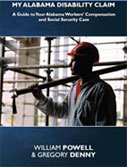
We Wrote the Book
My Alabama Disability Claim by William Powell & Gregory Denny Click Here to Get Your Free Copy


-
 5.0/5.0
A++++++ got results and staff is friendly
-
5.0/5.0
A++++++ got results and staff is friendly
-
5.0/5.0
Persevering for 2-3 years to get my disability. Thank You.
-
5.0/5.0
Persevering for 2-3 years to get my disability. Thank You.
-
 5.0/5.0
William Powell is an excellent attorney and a leader in our local bar.
