

Are Alabama Workers Compensation Medical Benefits Really for Life?
Understanding One of the Most Valuable Benefits Under Alabama Workers’ Compensation Law
When most people think about workers’ compensation, they think about weekly disability checks, and without a doubt those checks are important; but, for many seriously injured workers, the most valuable benefit may not be the weekly compensation at all. It may be the right to have your employer’s workers’ compensation insurance carrier continue paying for reasonable and necessary medical treatment related to your job injury—for the rest of your life.
That benefit is often worth far more than injured workers realize.
Recommended Reading: How do I get paid while I am off work? Understanding Alabama Workers’ Compensation Benefits
Medical Benefits Don’t Automatically End When Your Checks Stop
Many injured workers assume that once they return to work or their weekly disability benefits stop, workers’ compensation no longer has any responsibility.
That is usually not true.
Weekly disability benefits and medical benefits are two different things. Your Temporary Total Disability (TTD) or Temporary Partial Disability (TPD) benefits may end because:
- You return to work.
- You reach Maximum Medical Improvement (MMI).
None of those events automatically ends your right to future medical treatment.
If the treatment remains reasonable, necessary, and related to your compensable job injury, Alabama workers’ compensation may continue to pay for it long after your disability checks have ended.
Recommended Reading: What Is Maximum Medical Improvement (MMI)
What Does “Lifetime Medical Benefits” Really Mean?
Alabama’s Workers’ Compensation Act generally requires the employer to provide medical treatment that is:
- Reasonably necessary;
- Related to the compensable job injury; and
- Authorized under the Workers’ Compensation Act,
for life. That obligation does not necessarily end simply because years have passed since the accident.
For some workers, future medical treatment may include:
- Additional surgeries.
- Pain management.
- Prescription medications.
- Physical therapy.
- Diagnostic testing such as MRIs.
- Follow-up appointments with specialists.
- Medical equipment.
- Injections.
- Other treatment recommended by the authorized treating physician.
Some injured workers never need additional treatment, others may require care for decades.
Recommended Reading: What does “reasonable and necessary” medical care mean?
You Must Usually Continue Treating With the Authorized Treating Physician
Lifetime medical benefits do not mean you may simply choose any doctor you want. Under Alabama law, the employer generally has the right to select the initial authorized treating physician.
If you are dissatisfied with that physician under appropriate circumstances, Alabama law may allow you to request a Panel of Four physicians. Otherwise, treatment generally must remain within the authorized medical chain.
Recommended Reading: What is an Authorized Treating Physician, What does “Authorized Medical Treatment” mean and Can I change my Workers’ Compensation Doctor in Alabama?
What If I Need Another Surgery Ten Years From Now?
That happens more often than many people realize. Many orthopedic injuries gradually worsen over time.
Hardware may fail.
Joint replacements wear out.
Arthritis develops.
Adjacent spinal levels deteriorate.
If your authorized treating physician determines that additional treatment is reasonable, necessary, and causally related to your original job injury, workers’ compensation may still be responsible—even years after the accident.
Of course, insurance companies sometimes disagree. When that happens, disputes may arise over whether the requested treatment remains related to the original work injury.
What If I Have Another Accident?
This is an area where many injured workers become confused. Suppose you suffer a compensable back injury at work. Several years later, you are involved in a serious automobile accident. Does that automatically end your workers’ compensation medical benefits?
Maybe.
The important question is whether the treatment being requested remains related to the original job injury or whether the need for treatment results from the new accident. If the new accident “aggravates” your condition or creates an entirely separate injury, the employer may not be responsible for treatment related solely to that new condition.
On the other hand, if the original work injury continues to require treatment, or if there is a dispute over what caused the worsening of your condition, additional legal and medical issues may arise.
Every case depends upon its own facts.
Recommended Reading: Understanding Aggravations, Exacerbations, and Recurrences of Previous Injuries Under Alabama Workers’ Compensation Law
Should You Settle Your Future Medical Benefits?
Sometimes, but it is one of the most important decisions you will ever make in your workers’ compensation case.
In many settlements, the injured worker agrees to accept a lump sum of money in exchange for permanently giving up the right to future medical treatment under the Workers’ Compensation Act. Once approved by the court, that decision is generally permanent.
Before agreeing to close future medical benefits, you should carefully consider questions such as:
- Will I need another surgery?
- Will I require lifelong medication?
- What will future treatment cost?
- Will my private health insurance cover treatment related to my work injury?
- Am I eligible for Medicare now or in the future?
- Should a Medicare Set-Aside Arrangement be considered?
For many seriously injured workers, future medical benefits may ultimately prove more valuable than the cash paid to close them, while many other injured workers would rather be free to see whomever they decide for their medical care and not deal with workers’ compensation anymore.
Recommended Reading: Should You Give Up Lifetime Medical Benefits and What is a Medicare Set Aside?
Be Careful About Assuming Other Insurance Will Pay
One of the biggest mistakes injured workers make is assuming: “I’ll just use my health insurance later.”
Unfortunately, it is not always that simple.
Private health insurance policies may deny treatment they believe should be covered by workers’ compensation. Likewise, Medicare has rules governing payment for treatment related to work injuries and may require its interests to be considered when settling future medical expenses.
These issues should be carefully evaluated before agreeing to close future medical benefits.
The Law
Section 25-5-77, Ala. Code 1975, generally requires employers to furnish reasonably necessary medical and surgical treatment for compensable workplace injuries. Unless future medical benefits are properly settled and closed with court approval, the employer’s obligation to provide authorized, reasonable, necessary, and causally related medical treatment may continue long after disability benefits have ended. Since comp is paying for your medical care, you still must receive medical care from an authorized treating physician.
The Bottom Line
For many injured workers, future medical benefits are the most valuable part of an Alabama workers’ compensation claim.
Weekly disability checks eventually stop.
Medical needs often do not.
Before agreeing to settle away your right to future medical treatment, make sure you understand what you are giving up.
A settlement check may last only a short time.
The need for medical care may last the rest of your life.
At Powell and Denny, we have spent decades helping injured workers prove the connection between their workplace accidents and the benefits to which they are entitled under Alabama law.
If you have suffered a job injury and you have questions about your rights and benefits under Alabama’s workers compensation laws -don’t hesitate to contact and speak with one of the experienced Alabama Workers Compensation and Social Security Disability attorneys at Powell and Denny today for a free consultation. Appointments are available in person, or virtually via Zoom if more convenient. Powell and Denny would appreciate the opportunity to help. And remember, there is no fee unless you win.
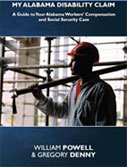
We Wrote the Book
My Alabama Disability Claim by William Powell & Gregory Denny Click Here to Get Your Free Copy


-
 5.0/5.0
A++++++ got results and staff is friendly
-
5.0/5.0
A++++++ got results and staff is friendly
-
5.0/5.0
Persevering for 2-3 years to get my disability. Thank You.
-
5.0/5.0
Persevering for 2-3 years to get my disability. Thank You.
-
 5.0/5.0
William Powell is an excellent attorney and a leader in our local bar.
