

What Is “Residual Functional Capacity” (RFC) in a Social Security Disability Case?
If you are applying for Social Security Disability benefits, you may hear the term “Residual Functional Capacity,” or “RFC.” For most people, that phrase does not mean much—but in reality, it is one of the most important parts of your disability case.
What Is Residual Functional Capacity?
Your Residual Functional Capacity (RFC) is a determination of what you are still able to do despite your medical condition. In other words, Social Security is not just looking at your diagnosis—they are asking:
“What can this person still do on a regular, full-time basis?”
This includes both:
- physical abilities, and
- mental abilities
Your RFC plays a central role in your case, especially at:
- Step 4 – Can you return to your past work?
- Step 5 – Can you do any other work?
Even if you have a serious medical condition, your claim may be denied if the Social Security Administration believes your RFC allows you to perform work on a sustained basis.
Your Physical RFC describes your ability to perform work-related activities such as:
- sitting, standing, and walking
- lifting and carrying
- pushing and pulling
- bending, stooping, or reaching
Based on these abilities, Social Security may determine that you can perform:
- sedentary work
- light work
- medium work
- or heavier levels of work
Mental RFC
If your claim involves mental health conditions, Social Security will also evaluate your mental RFC.
This includes your ability to:
- understand and follow instructions
- maintain concentration and focus
- interact with coworkers and supervisors
- handle stress and changes in routine
Mental limitations can be just as important as physical ones when determining whether you can work.
How Is RFC Determined?
Social Security determines your RFC by reviewing:
- your medical records
- your doctor’s opinions
- diagnostic testing
- your own statements about your limitations
In some cases, they may also rely on opinions from doctors who have never treated you, but who review your records.
Social Security is evaluating whether you can work on a regular and sustained basis—generally 8 hours a day, 5 days a week. Being able to perform a task occasionally is not the same as being able to do it consistently, day after day.
Why Medical Evidence Is So Important
Because RFC focuses on what you can still do, your medical records need to clearly show:
- your limitations
- how long you can sit, stand, or walk
- how your condition affects your daily functioning
A diagnosis alone is not enough—Social Security is looking for functional limitations, so be sure to inform your treating physicians of all the ways your medical conditions affect you. Simply saying everything is “the same” isn’t enough, describe your symptoms in detail so your medical records will accurately reflect how your condition affects your ability to engage in sustained work.
If you or someone you care for has recently been denied Social Security Disability benefits, or if you just have questions about your right to disability benefits, please do not hesitate to contact and speak with one of the experienced Social Security Disability Lawyers at Powell and Denny today for a free consultation; and remember, virtual appointments are available through Zoom so you can meet with one of the attorneys of Powell and Denny from wherever you live. And remember, there is no fee unless you win.
Powell and Denny: We Work When You Can’t
Offices in Huntsville, AL and Birmingham, AL
Alabama Disability Attorneys
Birmingham Social Security Disability Attorneys
Central Alabama Social Security Disability Lawyers
Hoover Social Security Disability Attorneys
Huntsville Social Security Disability Attorneys
North Alabama Social Security Disability Lawyers
Tennessee Valley Social Security Disability Lawyers
Powell and Denny have been selected as one of the Best Law Firms by U.S. News and World Report for each of the last 9 years, have been selected as one of Birmingham’s Top Lawyers by B-Metro Magazine for the last 5 years, have been selected by The National Advocates as one of the Top 20 Workers’ Compensation Firms (plaintiffs) and Powell and Denny, P.C.-has been selected as one of the “Best of the Best” law firms by The American Registry and included in the list as one of the Mid-South’s Super Lawyers.
Mr. Denny is AV rated by Martindale Hubbard (the highest rating possible) and Mr. Powell has been rated as Superior by The National Registry
+ Powell and Denny have successfully represented injured workers from Birmingham, Huntsville, Florence, Muscle Shoals, Tuscumbia, Athens, Decatur, Town Creek Ardmore, Hartselle, Madison, Toney, Scottsboro, Ft. Payne, New Hope, Guntersville, Albertville, Boaz, Ashville, Anniston, Gadsden, Cullman, Jasper, Gardendale, Morris, Kimberly, Centerpoint, Leeds, Tarrant City, Fairfield, Hueytown, Bessemer, Adger, Tuscaloosa, Cordova, Alabaster, Pelham, Harpersville, Opelika, Phenix City, Montgomery, Clanton, Calera, Enterprise, Monroeville, Mobile, Evergreen, Centreville, Brent, West Blocton, Woodstock, Brierfield, Lakeview and towns and cities in between.
What Is Residual Functional Capacity (RFC) in a Social Security Disability Case
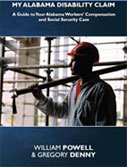
We Wrote the Book
My Alabama Disability Claim by William Powell & Gregory Denny Click Here to Get Your Free Copy


-
 5.0/5.0
A++++++ got results and staff is friendly
-
5.0/5.0
A++++++ got results and staff is friendly
-
5.0/5.0
Persevering for 2-3 years to get my disability. Thank You.
-
5.0/5.0
Persevering for 2-3 years to get my disability. Thank You.
-
 5.0/5.0
William Powell is an excellent attorney and a leader in our local bar.
