
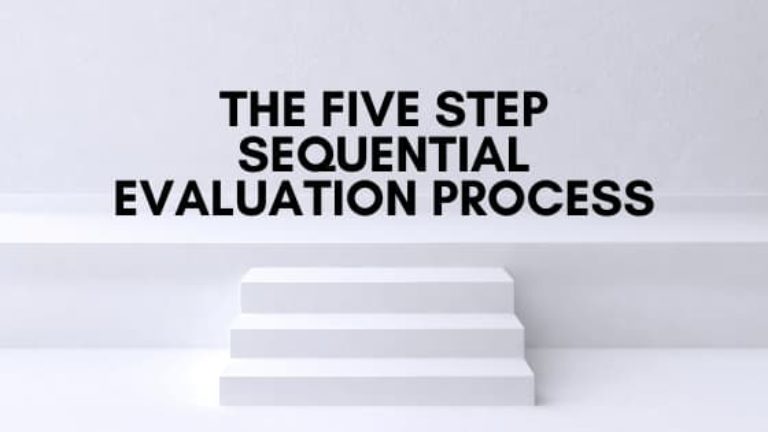
Can You Work and Still Receive Social Security Disability Benefits?
Understanding Step One of Social Security’s Five-Step Sequential Evaluation Process
Part Two of Powell & Denny’s Guide to Social Security Disability Benefits
Some people believe they must quit working before they can even apply for Social Security Disability benefits. Others believe that working even a few hours each week automatically disqualifies them.
The truth lies somewhere in between.
Working does not automatically prevent you from receiving Social Security Disability benefits. Likewise, quitting your job does not automatically qualify you for disability benefits.
Instead, Social Security applies a set of rules designed to answer one simple question:
Are you still capable of performing substantial work?
That question forms Step One of every Social Security Disability claim.
Where We Are in the Disability Process
The Powell & Denny Guide to Social Security Disability
✓ Part One
How Social Security Decides Disability
═══════════════════════════════
► PART TWO
Can You Work and Still Receive
Disability Benefits?
═══════════════════════════════
Part Three
Severe Impairments
Part Four
The Listings
Part Five
Residual Functional Capacity
Part Six
Other Work
Part Seven
Chronic Pain
Part Eight
Burden of Proof
Step One Isn’t About Your Medical Condition
This surprises almost everyone. When you apply for disability benefits, Social Security does not begin by reviewing your MRI. It does not begin by looking at your medical records. It does not ask your doctor whether you are disabled.
Instead, the very first question is much simpler: Are you currently working at a level that demonstrates you can still perform substantial work?
If the answer is yes, the disability evaluation usually ends. If the answer is no, your claim moves to Step Two.
That’s it.
Step One is not designed to determine whether you’re disabled, it simply determines whether Social Security should continue evaluating your claim.
Why Does Social Security Start Here?
Because disability benefits are intended for people whose medical conditions prevent them from maintaining substantial employment. If someone is already working at a level that demonstrates an ability to maintain competitive employment, Social Security generally will not continue evaluating the claim.
The Administration hasn’t decided whether you’re disabled. They have only answered the first question.
Think of It Like a Funnel
Everyone Who Applies
│
▼
Can You Perform Substantial Work?
│
Yes──┴──► Claim Usually Ends
│
No
▼
Medical Evidence Is Evaluated
Everything else—the medical records, your doctor’s opinions, your pain, your limitations—comes after this first question.
The Biggest Misconception About Disability Claims
One of the biggest misconceptions we hear is this: “I have to quit my job before I can apply.”
Not necessarily.
Here’s another one. “I’m still working a little, so there’s no point in filing.”
Again—not necessarily.
Every situation is different. The real issue isn’t whether you work, the issues are: Are you engaged in Substantial Gainful Activity, and what your work demonstrates about your ability to maintain competitive employment. That distinction is extremely important.
Recommended Reading:
What does Substantial Gainful Employment Mean?
What if I cannot Return to my Old Job?
If I Returned to Work, Could I Still Qualify for Disability Benefits?
Why This Matters
Imagine two people. Both suffer from severe back problems. Both experience daily pain. Both have undergone surgery.
The first person continues working forty hours every week without significant accommodations.
The second person attempts to work but repeatedly misses work because of pain, cannot complete a normal workday, and eventually has to stop.
Although both individuals have similar medical conditions, their work activities tell Social Security very different stories. That’s why Step One focuses upon work activity before moving into the medical evidence.
What If I Tried to Keep Working—but Couldn’t?
One of the most admirable things we see is that many disability applicants continue working for as long as they possibly can. They struggle through pain. They reduce their hours. They accept lighter-duty assignments for less pay. They miss work for medical appointments.
They do everything they can to support their families before finally reaching the point where continuing to work is no longer possible.
Many people worry that making this effort has hurt their disability claim. Fortunately, that is not always the case.
Social Security recognizes that some people attempt to return to work—or continue working—only to discover that their medical condition simply will not allow them to maintain competitive employment.
When that happens, the work may qualify as an Unsuccessful Work Attempt.
Generally speaking, an unsuccessful work attempt is employment that:
- lasts six months or less; and
- ends, or your earnings fall below Social Security’s substantial work level, because of your medical condition or because special accommodations that allowed you to work were removed.
When those circumstances exist, Social Security may disregard that period of work when deciding whether you were performing substantial gainful activity.
Why This Matters
Many people continue working because they genuinely hope their condition will improve, and those efforts are not automatically held against them. In fact, an unsuccessful attempt to continue working may actually help explain the progression of a disability and demonstrate just how difficult it became to remain employed.
The Bottom Line
Step One isn’t really about your health. It’s about your work.
Social Security first determines whether your work activity allows the disability evaluation to continue. Only after clearing that hurdle does the Administration begin evaluating your medical conditions.
That brings us to Step Two.
And despite what many people believe, Step Two is not where Social Security decides whether you’re permanently disabled.
Recommended Reading
Continue the Powell & Denny Guide to Social Security Disability
✓ Part One
How Social Security Decides Disability: The Five Questions That Determine Every Claim
➡ Coming Next
What Does Social Security Mean by a “Severe” Impairment?”
Recommended Reading:
- Residual Functional Capacity (RFC): Where Many Disability Cases Are Won or Lost
- Can Chronic Pain Qualify You for Social Security Disability Benefits?
Next in This Series
What Does Social Security Mean by a “Severe” Impairment?
Many disability applicants hear the word “severe” and immediately think Social Security is deciding whether they are permanently disabled.
That’s not what Step Two is about. In the next article, we’ll explain:
- What makes an impairment “severe”;
- Why multiple impairments matter;
- How physical and mental conditions are considered together;
- Why the twelve-month rule is important; and
- Why Step Two is often one of the easiest hurdles to clear—even though many people misunderstand it.
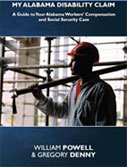
We Wrote the Book
My Alabama Disability Claim by William Powell & Gregory Denny Click Here to Get Your Free Copy


-
 5.0/5.0
A++++++ got results and staff is friendly
-
5.0/5.0
A++++++ got results and staff is friendly
-
5.0/5.0
Persevering for 2-3 years to get my disability. Thank You.
-
5.0/5.0
Persevering for 2-3 years to get my disability. Thank You.
-
 5.0/5.0
William Powell is an excellent attorney and a leader in our local bar.
